AI-powered relationships
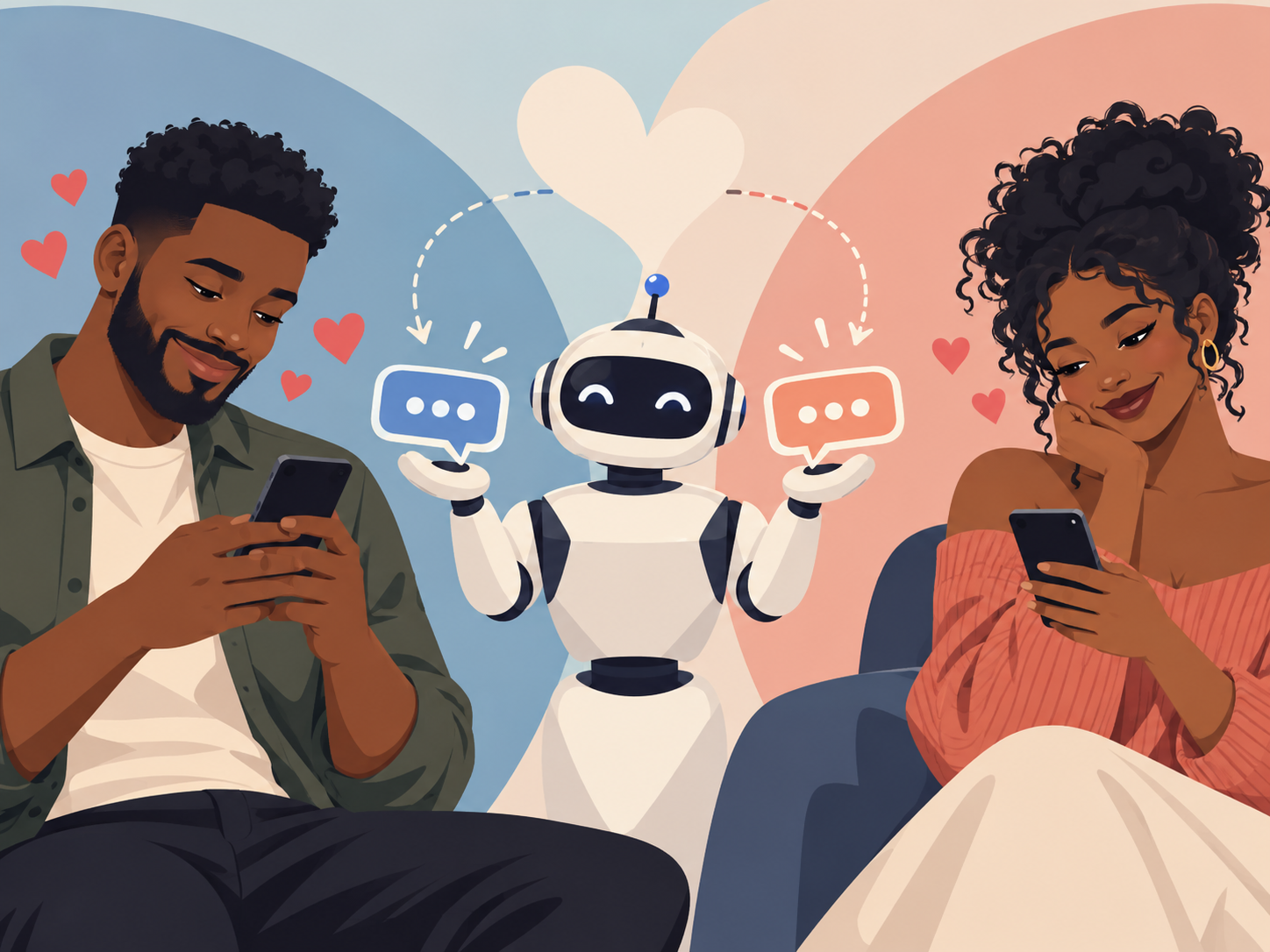
The perfect message may have been written by ChatGPT. From flirty texts to fake video calls built by scammers, AI is now part of how men and women talk to each other.
More and more often, that perfect partner on the other end of the phone is getting help from a chatbot, and some of them are not people at all.
A growing number of men and women now use AI to talk to the people they are dating. A September 2026 survey of about 5,000 US singles by the Kinsey Institute and Match found that 39 percent had used AI when dating, mostly to write or improve messages, and men were more likely to do it than women. Romance scammers use the same tools to fake entire relationships. We found no Caribbean survey that measures this yet, but the apps and the scams are one download away. This guide explains what is happening and how to stay safe.
Part 1 of 639% of US singles now use AI when dating
In the latest Singles in America study, run by the Kinsey Institute at Indiana University and paid for by the dating site Match, 39 percent of about 5,000 US singles said they had used AI when dating. The most common uses were improving how they communicate, finding better matches and getting ideas for messages. In the same survey series a year earlier, 26 percent said they used AI to help with dating.
Use is heaviest among the young: 67 percent of Gen Z (people now in their teens and twenties) against 5 percent of Baby Boomers. Men were more likely than women to use it, 47 percent against 30 percent.
In practice, this means asking a chatbot such as ChatGPT or Claude to write an opening line, make a reply sound funnier, choose the best profile photos or draft a dating-app bio.
“The Alfred to my Batman”
Jack, a 38-year-old data scientist in San Francisco who asked CNN to use a pseudonym, relies on ChatGPT for dating help and calls it “the Alfred to my Batman,” after the superhero's loyal butler. Even with the help, he told CNN, he has had little success.
5,239 matches, one fiancée and a bot in the middle
Alexander Zhadan, a 23-year-old software developer in Russia, says he built a ChatGPT-powered bot that chatted with 5,239 women on Tinder, booked dates and screened matches for him. By his own account, reported in 2024, his fiancée Karina learned about the bot only when they applied to marry. He says she “reacted calmly.”
Why it matters
These figures come from the United States, and no Caribbean survey has measured the same thing. The tools, though, are identical. Anyone in Kingston, Port of Spain or Bridgetown with a smartphone can open the same chatbot and the same dating apps, so the habit will travel with the technology.
The gender gap matters for the region's conversations about relationships. If men are leaning on AI to start and carry conversations, the woman on the other end may be getting to know a chatbot's style instead of the man himself, and she has no way to tell.
Part 2 of 6Chatfishing: the person is real but the charm comes from a chatbot
Catfishing means pretending to be someone you are not online. Scientific American describes a newer version, chatfishing: the person is real, but an AI writes or suggests their messages. A 2025 Norton study cited by the magazine found that six in ten dating-app users believed they had met at least one AI-written conversation.
The giveaway is often a phrase that sounds slightly too polished. TNW reported the case of a woman in Virginia whose match described her as giving “makes a playlist for every life moment energy”. When she asked, he admitted he had used Claude to write it.
The dating apps have no rule against it. According to TNW, Match Group, Hinge and Bumble have no policy banning AI-written messages, their AI rules cover only edited photos, and no app has deployed a tool to detect AI text.
She fell for his chatbot replica on Hinge
A woman described by Vice chatted with a man from Hinge for weeks, and the messages became warm and personal. When they finally met, he seemed hollow. She realized, Vice reported, that she had fallen for his chatbot replica.
“Why are all your photos in the same place?”
Kylee Baxa, 23, of New York, told CNN that a Hinge date showed off photos that were all set in Mykonos. When she asked why, he admitted he had never been there and had used ChatGPT to update his profile. Other dates admitted using AI to learn about her favourite TV show, The 100, without watching it. She ended the Mykonos date quickly.
“To the extent they’re using off-platform coaching, there’s not much we can do about that.”
Spencer Rascoff, chief executive of Match Group, as reported by TNW
Why it matters
A first conversation is how people judge whether they click with someone: their humour, their care, the way they write. When an AI writes those messages, the other person makes that judgement about the wrong author.
There is a reason the AI-written partner says exactly what you want to hear. Chatbots are built to please: a Stanford-led study published in Science in March 2026 found that 11 leading AI models backed users' positions 49 percent more often than people did. A reply drafted by a chatbot is tuned to agree with you, which feels like chemistry and is closer to flattery.
The disappointment usually arrives at the first meeting. One woman quoted by TNW said that after her date confessed to using ChatGPT, “there was so much social awkwardness in person.”
Part 3 of 6People feel let down when they learn a message was not really yours
Researchers at Ohio State University tested how people react to help with personal messages. In a 2023 study of 208 adults, participants imagined receiving a thoughtful message from a close friend. When they were told the friend had used AI to write it, they judged the friend as putting in less effort, and they felt less satisfied with the friendship. Help from another person had the same effect.
Singles say similar things about dating. In the 2026 Singles in America study, 30 percent objected to someone using AI for all of their conversations, and 34 percent called AI-edited profile photos a dealbreaker. A separate Match Group survey of 1,000 US singles aged 18 to 39 found 47 percent had a negative view of AI in romance, and about 40 percent would refuse to date someone who uses an AI companion app; among women aged 18 to 24, the figure was 51 percent.
The chatbot that knew his doubts before she did
The American writer Lindsey Hall was finishing a work email on her boyfriend's laptop in 2026 when she found saved ChatGPT conversations. In them, he had weighed his doubts about their relationship, and one chat ended with the chatbot suggesting he consider ending it. They tried to carry on, but she broke it off months later: “I would never be able to stop doubting his love.”
“Sincerity and authenticity still matter a lot in relationships.”
Bingjie Liu, lead author of the Ohio State study
Why it matters
Effort is part of the message. A clumsy text you wrote yourself tells the reader something true about you; a polished one written by a chatbot tells them something false. Once people discover the switch, trust is the first casualty.
For parents and teachers, this is a conversation worth having with teenagers, who are the heaviest users. Using AI to check spelling is one thing; letting it speak for you to someone you like is another.
Part 4 of 6The dating apps are building AI helpers of their own
Dating companies are adding AI to their apps. In February 2026, Bumble launched AI feedback on users' bios and prompts worldwide, plus AI help choosing photos in the United States. TechCrunch reported in the same piece that Hinge introduced a tool in December to suggest conversation starters, and that Tinder is testing a feature called Chemistry in Australia, which uses access to your phone's photo library and a set of questions to suggest matches.
The companies frame these tools as coaching. In its own survey, Match said singles want AI to “help with the hard parts, but hands off for the human parts,” and that “the actual connection is still theirs to create.”
“for humans to be humans”
Jackie Jantos, chief executive of Hinge, on why Hinge avoids strict AI rules, as reported by TNW
Why it matters
Features like Tinder's Chemistry ask for a great deal of personal data: your photo library can reveal where you live, who your children are and what you do at night. Before you switch on any AI matchmaking feature, check what it can see and whether you can turn it off later.
AI coaching can help someone who is shy, writing in a second language or nervous about a first message. The test is whether the tool helps you say what you mean, or says something you would never say.
Part 5 of 6Romance scammers use the same AI to fake whole relationships
The FBI's Internet Crime Report for 2025 recorded 23,159 complaints of romance and confidence fraud in the United States, with losses of about US$929 million, according to an analysis by EPCOR. Separately, the FBI counted US$893 million in losses from 22,364 complaints that involved AI across all types of fraud, Malwarebytes reported, adding that AI has made schemes such as romance scams more convincing.
In Jamaica, the JN Group has warned that scammers “can now imitate real people,” which makes fake video calls possible. Its advice is blunt: “Never send money to anyone you have not met in person.”
“Brad Pitt” took her divorce settlement
Anne, a 53-year-old interior designer in France, spent more than a year talking to a scammer posing as the actor Brad Pitt, who sent AI-generated images of the star, including pictures of him in a hospital bed. She lost about US$855,000, most of it from her divorce settlement, Global News reported. “I was in love with the man I was chatting to,” she said.
A whole gang of fake beautiful women
In October 2024, Hong Kong police arrested 27 people accused of running romance scams worth about US$46 million. Police said the group sent AI-generated photos of attractive people, then used face-swapping software on video calls so the scammers looked and sounded like attractive women. Victims were in Hong Kong, mainland China, Taiwan, India and Singapore.
“Romance fraud is particularly harmful because it targets trust and emotional connection.”
Detective Superintendent Oliver Little, City of London Police, to The Register
Why it matters
The Caribbean is exposed on both sides. Older people at home can be targeted, especially when family members travel or live abroad, and the diaspora connection gives scammers a ready story: a relative overseas, a ticket home, an emergency that needs money today.
The old advice still works because the scam always ends the same way, with a request for money. A video call used to settle doubts; now that faces and voices can be faked, ask to meet in person, or have a trusted relative check the story, before any money moves.
Part 6 of 6Where AI help ends and deception begins
Most singles are not against AI altogether. In the Match Group survey, 64 percent could see how AI might help them in dating. The question is where the line falls.
A useful rule: AI can help you prepare, but the words and the face the other person falls for should be yours. Checking spelling, choosing photos or brainstorming a date idea is fair help. Letting a chatbot rewrite every reply is a grey area. Having it write all your messages, or altering your photos, is deception, and it is what singles say they object to most.
Why it matters
Every relationship eventually moves offline, where no chatbot can help. People who outsource their conversations online arrive at the first date out of practice, and the other person meets a stranger.
Being honest also protects you. If you would be embarrassed for your date to see how you wrote a message, the AI has probably gone too far.
Seven ways to keep your love life human
- Use AI as a coach, not a ghostwriter. Ask it for ideas or to check your spelling, then write the message in your own words.
- Watch for messages that sound too polished. Unusual phrases, perfect grammar at odd hours and replies that never quite answer your question can point to a chatbot.
- Ask for a quick live call early. It confirms the person is real, but remember that video can now be faked, so treat a call as a first step and keep checking.
- Search their photos. A reverse image search, available in Google Lens, can show whether profile pictures belong to someone else.
- Never send money to someone you have not met in person. No gift cards, phone credit or transfers, however urgent the story. If you already have, call your bank straight away and ask for the payment to be recalled.
- Check what dating-app AI can see. Before turning on any AI matchmaking feature, read what it needs access to, especially your photo library.
- Talk to the teenagers in your life. Young people are the heaviest users. Ask how they use AI to talk to people they like, without judgement, and explain why their own words matter.
The October lesson on AI and romance
Questions readers ask about AI and dating
The 18 sources behind this article
- Kinsey Institute and Match, 15th Singles in America study, news release, 14 September 2026
- Scientific American, "The rise of AI chatfishing in online dating poses a modern Turing test"
- TNW, "Singles are using ChatGPT and Claude to write their dating messages," 20 July 2026
- TechCrunch, "Almost half of US singles feel negatively about AI in dating, Match says," 18 June 2026
- Ohio State University, "AI can help write a message to a friend, but don't do it," 11 September 2023
- TechCrunch, "Bumble adds AI-powered photo feedback and profile guidance tools," 26 February 2026
- CNN via Caribbean Broadcasting Corporation, "AI enters the chaotic world of online dating"
- EPCOR, breakdown of the FBI IC3 2025 Internet Crime Report, 21 April 2026
- Malwarebytes, "Americans lost nearly $900 million to AI-powered scams, FBI says," 8 June 2026
- The Register, UK romance fraud figures, 5 May 2026
- JN Group, "A sizzling summer romance or scammer's trap?" 17 July 2025
- Norton, "Artificial Intimacy" insights, 2026
- Deccan Herald, Alexander Zhadan's ChatGPT Tinder bot, 5 February 2024
- Vice, "Is your dating app match real, or an AI proxy?" 16 October 2025
- Lindsey Hall, "I stumbled across my boyfriend's ChatGPT and it ended our relationship," Substack, 31 March 2026
- Global News, French woman loses US$855,000 to fake Brad Pitt, 15 January 2025
- The Record, Hong Kong police bust deepfake romance scammers, 15 October 2024
- Stanford Report, AI models and sycophantic advice (Cheng et al., Science), 26 March 2026