An AI Strategy for CARICOM
SOVEREIGN INTELLIGENCE: A STRATEGIC ANALYSIS OF GLOBAL AI GOVERNANCE AND CARIBBEAN CURRICULUM INTEGRATION
A National Policy Framework and Educational Strategy for 2026–2030
PREPARED FOR:
The Conference of Heads of Government of the Caribbean Community (CARICOM)
AUTHOR:
Adrian Dunkley, Strategic AI Advisor - Expert in AI Governance, National Strategy, and Sovereign Capability Building
DATE: February 4, 2026
SECURITY CLASSIFICATION: OPEN // POLICY ADVISORY
TABLE OF CONTENTS
1.0 EXECUTIVE TRANSMITTAL
1.1 The "Amplify, Not Replace" Mandate
1.2 Summary of Strategic Recommendations
2.0 PART I: THE STRATEGIC CONTEXT (THE 2026 LANDSCAPE)
2.1 The Global Fracturing: Navigating US, EU, and Asian Regulatory Blocs
2.2 The Economic Imperative: Moving from 1% to 10% GDP Growth
2.3 The "Trust Deficit": Lessons from Global AI Scandals
3.0 PART II: THE "SOVEREIGN INTELLIGENCE" CURRICULUM FRAMEWORK
3.1 Philosophical Pillars: Human-in-the-Loop Pedagogy
3.2 Core Competencies Matrix (K-12 to Tertiary)
3.3 The "AI Civics" Module: Countering Hallucination and Bias
4.0 PART III: OPERATIONAL GOVERNANCE & INFRASTRUCTURE
4.1 The "Red-Amber-Green" Tooling Assurance Model
4.2 Digital Operational Resilience (DORA) and Offline-First Architecture
4.3 Data Sovereignty: The Caribbean Curriculum Data Lake
5.0 PART IV: MEMBER STATE "TRAILER" STRATEGIES
5.1 Jamaica: The Digital Services & KPO Transition Protocol
5.2 Trinidad & Tobago: The Industrial AI & Predictive Maintenance Protocol
5.3 Guyana: The Rapid Infrastructure & Accelerated Learning Protocol
5.4 Barbados: The Blue Economy & Climate Data Protocol
5.5 The Bahamas: The High-Touch Service & Hospitality Protocol
5.6 OECS: The Federated Learning & Shared Services Protocol
6.0 PART V: IMPLEMENTATION MATRIX
6.1 Timeline (2026–2028)
6.2 Funding Instruments and ROI Analysis
7.0 REFERENCES
NOTICE OF ORIGIN & ATTRIBUTION
This strategic policy framework has been developed and donated to the Caribbean Community (CARICOM) by regional Artificial Intelligence expert Adrian Dunkley.
It is presented as an independent advisory contribution to support the region’s technological sovereignty and economic resilience. While formulated for high-level consideration, this document does not currently represent the official policy, legislation, or ratified stance of the CARICOM Secretariat or its Member States until formally adopted.
1.0 EXECUTIVE TRANSMITTAL
1.1 The "Amplify, Not Replace" Mandate
The Caribbean region stands at a definitive crossroads. As of early 2026, the global artificial intelligence landscape has matured from experimental novelty to a critical driver of national power. The United States, driven by the Executive Order of December 11, 2025, has aggressively moved to secure technological superiority, explicitly framing AI as a matter of economic growth and national security. Simultaneously, state-level enforcement actions in the U.S. have demonstrated that AI misuse carries severe legal and reputational penalties, with State Attorneys General actively prosecuting algorithmic discrimination and failure.
In this volatile environment, passive adoption of foreign AI tools is a strategic liability. This document outlines a path to Sovereign Intelligence. We define this not as the rejection of global tools, but as the capability to govern, audit, and contextualize them.
Our Mandate is Clear: We will not use AI to replace the Caribbean teacher or the Caribbean worker. We will use AI to amplify their capacity, creating a workforce that manages, critiques, and orchestrates intelligent systems rather than one that is displaced by them.
1.2 Summary of Strategic Recommendations
This strategy proposes a radical restructuring of the regional education system, moving beyond "digital literacy" to "AI Agency."
Curriculum: Mandatory "AI Ethics & Auditing" from secondary school levels to immunize citizens against misinformation.
Infrastructure: Adoption of "Edge AI" (offline-first) to ensure resilience against climate-driven connectivity failures, aligned with Digital Operational Resilience Act (DORA) principles.
Differentiation: Specific economic "Trailer" protocols for each Member State, recognizing that the AI needs of Guyana's construction boom differ vastly from Barbados's tourism sector.
Governance: A "Red-Amber-Green" maturity model for AI tool procurement, ensuring no "black box" algorithms determine student outcomes without human oversight.
2.0 PART I: THE STRATEGIC CONTEXT (THE 2026 LANDSCAPE)
2.1 The Global Fracturing: Navigating Regulatory Blocs
The unified global internet is receding. In its place, we see the emergence of "AI Sovereignty" zones. The US Administration’s AI Action Plan and subsequent Executive Orders of 2025 have explicitly framed AI as a domain of national competitiveness. The establishment of the DOJ AI Litigation Task Force signals a federal intolerance for inconsistent regulations, with mandates to challenge state laws that burden interstate commerce.
Implication for CARICOM: We cannot simply "copy-paste" regulations.
The US Model: Focuses on deregulation and challenging "woke AI" policies to foster innovation and maintain superiority vis-à-vis China.
The EU/OECD Model: Emphasizes safety, reporting frameworks like the Hiroshima AI Process (HAIP), and mitigating "real-world harm".
The Caribbean Stance: We will adopt a "Hybrid-Risk" approach—aligning with US standards for commercial innovation to encourage foreign investment, while adopting OECD-style safety reporting for AI used in public sectors like education and health.
2.2 The Economic Imperative: From 1% to 10% Growth
The OECD projects that successful AI adoption could catalyze global productivity growth from a baseline of 1-7% to a 10-fold increase in the coming decades. For the Caribbean, this is not about incremental gain; it is about survival.
The Threat: Our primary export—services (tourism, BPO, finance)—is the sector most vulnerable to automation.
The Opportunity: By integrating AI into our curriculum now, we pivot our workforce from "Service Providers" to "Experience Architects." We do not train students to answer phones; we train them to design the AI agents that answer phones.
Resilience: Financial services organizations must now adhere to DORA standards, proving they can "withstand and recover from disruption, not just prevent it". This resilience mindset must extend to our education systems.
2.3 The "Trust Deficit": Lessons from Global AI Scandals
We must be clear-eyed about the risks. The OECD notes that "high-profile failure in one AI system can erode confidence in a broader array of government use cases".
Recent Precedent: In 2025, mass-market AI tools faced backlash when users withdrew from data sharing due to trust violations. High-profile settlements, such as the $2.5 million fine against a student loan company for AI-driven discrimination, illustrate the cost of unchecked algorithms.
The Education Risk: If we deploy AI tutors that "hallucinate" (invent facts) about Caribbean history or provide biased grading, we will face a parental revolt.
Strategic Response: The curriculum must prioritize Transparency. Following the lead of California’s Transparency Acts, all AI-generated educational content must be labeled, and students must be taught to use "AI detection tools" as part of their standard literacy.
3.0 PART II: THE "SOVEREIGN INTELLIGENCE" CURRICULUM FRAMEWORK
3.1 Philosophical Pillars: Human-in-the-Loop Pedagogy
Policy Statement: All AI-enabled educational tools deployed in Member States must be architected to amplify, not replace, the cognitive agency of the student and the authority of the teacher.
We observe that "AI misuse and scandals can undermine trust and contribute to public resistance". To mitigate this, Caribbean classrooms will adopt a "Teacher-in-the-Loop" governance model. AI will handle diagnostic grading and personalized lesson planning, but certification and critical feedback remain human domains.
The "Amplify" Standard:
Prohibited: AI tools that write essays or solve equations without showing intermediate steps.
Mandated: AI tools that act as "Socratic Tutors," asking questions to guide students rather than providing answers
3.2 Core Competencies Matrix (K-12 to Tertiary)
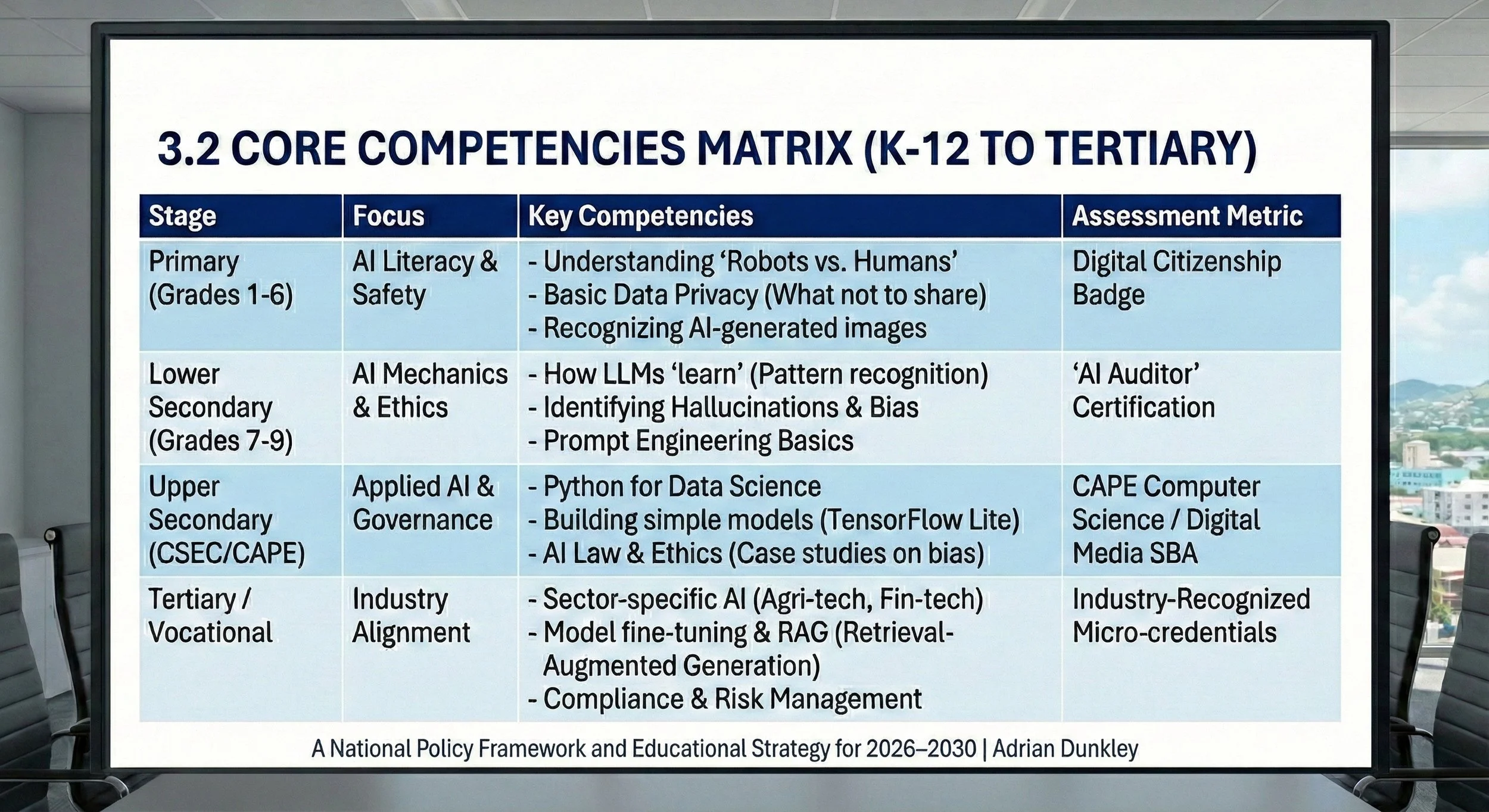
Core Competencies Matrix (K-12 to Tertiary)
3.3 The "AI Civics" Module: Countering Hallucination and Bias
Given that Generative AI providers must now "embed latent disclosures" in content, our students must be trained to look for them.
Curriculum Integration: A mandatory module on Information Integrity. Students will learn to cross-reference AI outputs with primary sources.
Cultural Defence: Students will specifically test global models for "Caribbean Bias"—identifying where models fail to understand Creole, local geography, or historical nuances. This turns "bias" from a passive harm into an active learning opportunity.
4.0 PART III: OPERATIONAL GOVERNANCE & INFRASTRUCTURE
4.1 The "Red-Amber-Green" Tooling Assurance Model
To manage risk without stifling innovation, we will adopt a tiered procurement framework inspired by the ISO 42001 and NIST frameworks.
RED (High Risk):
Definition: "Black box" models with no transparency; tools that claim to predict student potential or behavioral risks without explainability.
Policy: Strictly Prohibited for student assessment. Permitted only for supervised research by faculty.
AMBER (Managed Risk):
Definition: Commercial GenAI tools (e.g., ChatGPT, Claude) that are powerful but prone to hallucination.
Policy: Restricted Use. Requires mandatory "Output Verification Logs" where students must highlight and correct errors in the AI's output.
GREEN (Certified Sovereign):
Definition: Tools trained or fine-tuned on the "Caribbean Curriculum Data Lake" (see 4.3); tools with robust privacy-enhancing technologies.
Policy: Preferred Procurement. Fast-track approval for schools.
4.2 Digital Operational Resilience (DORA) and Offline-First Architecture
The Caribbean is a climate-vulnerable region. We cannot build an education system dependent on 100% uptime of undersea cables.
The DORA Standard: We must "prove we can withstand and recover from disruption".
Edge AI Strategy: Procurement will favor "Edge-Native" devices—laptops and tablets capable of running Small Language Models (SLMs) locally, without internet access.
Disaster Continuity: In the event of a hurricane, AI tutoring systems must remain functional to ensure learning continuity in shelters or disconnected communities.
4.3 Data Sovereignty: The Caribbean Curriculum Data Lake
Current global models are trained on data that underrepresents the Caribbean. To fix this, we will build a Sovereign Data Asset.
Action: Ministries of Education will partner with UWI and UTech to digitize and sanitize local textbooks, literature, historical archives, and civic data.
Usage: This data will be used to "fine-tune" open-source models (like Llama or Mistral), creating a "Caribbean Copilot" that understands our context.
Governance: Strict adherence to data privacy laws, ensuring no student PII (Personally Identifiable Information) enters the training set.
5.0 PART IV: MEMBER STATE "TRAILER" STRATEGIES
The following sections outline specific adaptations of the master strategy for individual Member States, acknowledging their unique economic and industrial contexts.
5.1 🇯🇲 JAMAICA: The Digital Services & KPO Transition Protocol
Strategic Context:
Jamaica is the region's BPO (Business Process Outsourcing) hub. This sector is facing an existential threat from AI agents that can handle Tier 1 customer service. However, Jamaica also has the strongest potential to pivot to KPO (Knowledge Process Outsourcing) and Creative Industries.
Sector-Specific Curriculum:
HEART/NSTA Trust Pivot: Rebrand "Call Centre Training" to "AI Customer Experience Management." Trainees learn to supervise AI agents, handling complex escalations that AI cannot manage.
Creative Tech: Leverage Jamaica's cultural brand. Introduce "Generative Media" courses at the Edna Manley College, teaching artists to use AI for animation, music production, and digital fashion, ensuring IP protection is central to the syllabus.
Regulatory Stance: Align with California's Transparency Acts. Jamaican creative exports (music, art) generated with AI assistance must be clearly labelled to protect the "Brand Jamaica" premium of authentic human creation.
5.2 🇹🇹 TRINIDAD & TOBAGO: The Industrial AI & Predictive Maintenance Protocol
Strategic Context:
As an energy-based economy, T&T’s priority is industrial efficiency and safety. The focus is not on generative text, but on predictive analytics and robotics.
Sector-Specific Curriculum:
Tertiary Focus (UTT/UWI): Mandatory modules on "Industrial IoT and AI" for engineering students. Focus on sensor data analysis, digital twins, and predictive maintenance algorithms for oil and gas infrastructure.
Safety Critical Systems: Adopt strict governance for AI in industrial settings. Align with ISO 42001 standards for high-risk AI management.
Workforce Reskilling: A national "Energy AI" fellowship to upskill current petrochemical engineers in data science, ensuring they can interpret the outputs of new automated monitoring systems.
5.3 🇬🇾 GUYANA: The Rapid Infrastructure & Accelerated Learning Protocol
Strategic Context:
Guyana is the fastest-growing economy in the hemisphere, undergoing a massive infrastructure boom. The constraint is human capital—there are not enough engineers or planners.
Sector-Specific Curriculum:
Urban Planning & Civil Engineering: Integrate AI tools for "Generative Design" in construction and urban planning at the University of Guyana. Students must learn to use AI to optimize building layouts and traffic flows.
Accelerated Education: Use AI-driven "Adaptive Learning Platforms" to compress vocational training timelines. Instead of 2-year trade degrees, use AI tutors to deliver personalized, rapid upskilling in electrical and mechanical trades to meet immediate labor demands.
Sovereign Data: Enforce strict data residency laws for geological and seismic data processed by AI, ensuring national assets remain under sovereign control.
5.4 🇧🇧 BARBADOS: The Blue Economy & Climate Data Protocol
Strategic Context:
Barbados is a global leader in climate finance (Bridgetown Initiative) and high-end tourism.
Sector-Specific Curriculum:
Environmental Data Science: Introduce "Climate AI" in secondary schools. Students learn to use AI to model coastal erosion, coral reef health, and weather patterns using satellite data.
Smart Tourism: A "High-Touch, High-Tech" hospitality curriculum. Training hotel staff to use AI for backend personalization (anticipating guest needs) while maintaining the "human face" of service.
Policy Leadership: Barbados should position itself as the "Regional AI Ethics Hub," hosting the regulatory bodies that audit AI safety for the Caribbean, similar to how it leads in climate policy.
5.5 🇧🇸 THE BAHAMAS: The High-Touch Service & Hospitality Protocol
Strategic Context:
The Bahamas relies on luxury tourism and financial services. Trust and personalization are the currencies of the economy.
Sector-Specific Curriculum:
FinTech Governance: For the financial services sector, align training with DORA resilience standards. Financial professionals must be trained in "AI Risk Management" to prevent algorithmic trading errors or fraud.
Hospitality Management: Curriculum focus on "AI-Augmented Concierge" services. Using AI to manage logistics and inventory so that human staff can focus entirely on guest interaction.
Digital Traceability: Implementation of AI watermarking for marketing materials to ensure authenticity in tourism promotion, avoiding "deepfake" destinations that could harm the brand.
5.6 🏳️ OECS (Organization of Eastern Caribbean States): The Federated Learning Protocol
Strategic Context:
Smaller island states (Grenada, St. Lucia, Dominica, etc.) lack the individual data volume to train robust models or the budget for massive hardware procurement.
Sector-Specific Curriculum:
The "Education Cloud": A shared OECS initiative to pool educational data. By using "Federated Learning" (where models learn from decentralized data without moving it), the OECS can build a powerful shared education model while respecting the data sovereignty of each island.
Remote Expert Access: Use AI-enabled tele-education to project expert teachers from one island to classrooms in another, solving teacher shortage issues.
Shared Procurement: A unified "OECS AI Hardware" procurement block to negotiate better rates for Edge AI tablets and servers.
6.0 PART V: IMPLEMENTATION MATRIX
6.1 Timeline (2026–2028)
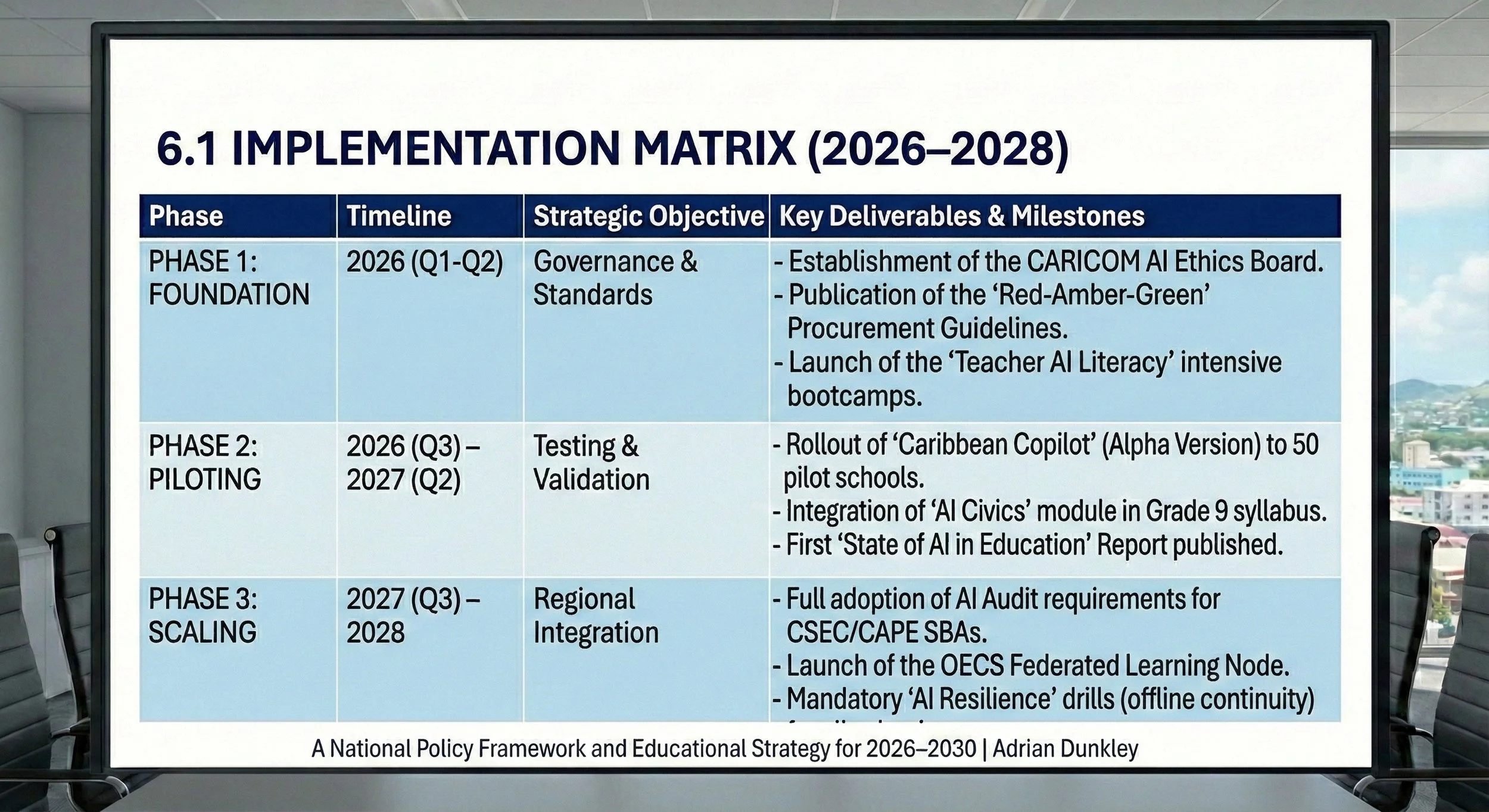
Implementation Matrix
6.2 Funding Instruments & ROI Analysis
To finance this transition, we will move beyond traditional budget allocations.
Public-Private Partnerships (PPP): Collaborate with the "Frontier Model Forum" and "AI Alliance" to secure subsidized access to compute resources for Caribbean universities.
Development Bank Financing: Leverage the "AI Capacity Building" funding mechanisms proposed by the UN and international bodies.
ROI Projection: Investment in AI education is projected to yield high returns by reducing the "skills gap" in the services sector and creating a new class of high-value "Knowledge Workers" capable of remote export of services.
7.0 REFERENCES
OECD (2025). Launch of the Hiroshima AI Process (HAIP) Reporting Framework.
OECD (2024). Understanding AI’s transformative potential.
Center for AI and Digital Policy (2025). AI Action Plan (OSTP 2025).
Sidley Austin LLP (2025). Unpacking the December 11, 2025 Executive Order: Ensuring a National Policy Framework for Artificial Intelligence.
Mayer Brown (2025). President Trump Issues Executive Order on “Ensuring a National Policy Framework for Artificial Intelligence”.
Kiteworks (2026). AI Regulation in 2026: The Complete Survival Guide for Businesses.
Presidio (2026). The Top Security, Risk, and AI Governance Frameworks CISOs Must Prioritize for 2026.
ICLG.com (2026). China's Key Developments in Artificial Intelligence Governance in 2025-2026 (Referencing California Transparency Acts).
Schellman (2026). AI Governance & ISO 42001 FAQs.
Brookings Institution. Network architecture for global AI policy.
Other Sources
Baker Donelson (2026). 2026 AI Legal Forecast: From Innovation to Compliance.
Office of the Chair of the International AI Safety Report (2026). 2026 International AI Safety Report Charts Rapid Changes and Emerging Risks.
Wilson Sonsini Goodrich & Rosati (2026). 2026 Year in Preview: AI Regulatory Developments for Companies to Watch Out For.
A Strategic Analysis of Global Artificial Intelligence Governance (2026). A Strategic Analysis of Global Artificial Intelligence Governance: National Strategies, Regulatory Enforcement, and Risk Management Frameworks for 2026.
European Commission (2026). AI Act | Shaping Europe's digital future.
Center for AI and Digital Policy (2025). AI Action Plan (OSTP 2025).
Schellman (2026). AI Governance & ISO 42001 FAQs—What Organizations Need to Know in 2026.
Kiteworks (2026). AI Regulation in 2026: The Complete Survival Guide for Businesses.
G2 (2026). AI Regulations: Stats and Global Laws for SaaS Teams.
The AI Security Institute (2026). AISI Research & Publications.
Reed Smith (2025). China Approves Major Amendments to Cybersecurity Law, Effective 1 January 2026.
China Briefing (2025). Revisions to China’s Cybersecurity Law: Strengthened Oversight and Alignment with Emerging Technologies.
Artificial Intelligence Act (n.d.). EU AI Act - Updates, Compliance, Training.
Presidio (2026). Enterprise AI Governance: How to Play Defense When You Can’t Stop Every Yard.
Center for Long-Term Cybersecurity (2025). Event Recap – Establishing AI Risk Thresholds and Red Lines: A Critical Global Policy Priority.
Alston & Bird (2025). First Milestone in the Implementation of the EU AI Act.
OECD (2025). How artificial intelligence is accelerating the digital government journey.
Hicomply (2025). Confused by AI Frameworks? Here's How ISO 42001 and NIST AI RMF Compare.
ISMS.online (2025). ISO 42001 vs NIST AI RMF.
Future of Life Institute (2024). Implementation Timeline | EU Artificial Intelligence Act.
Credo AI (2025). Latest AI Regulations Update: What Enterprises Need to Know in 2026.
OECD (2025). Launch of the Hiroshima AI Process (HAIP) Reporting Framework.
OECD.AI (2026). National AI Strategy.
Brookings Institution (2025). Network architecture for global AI policy.
OECD (2026). OECD Digital Education Outlook 2026: Exploring Effective Uses of Generative AI in Education.
OECD.AI (2026). OECD's live repository of AI strategies & policies.
SpeakUp (2026). Philosophy vs velocity: the great AI governance divide.
Mayer Brown (2025). President Trump Issues Executive Order on “Ensuring a National Policy Framework for Artificial Intelligence”.
Paul Hastings LLP (2025). President Trump Signs Executive Order Challenging State AI Laws.
Brookings Institution (2026). On the road to the India AI Impact Summit: Global AI governance and the HAIP Reporting Framework.
Hiroshima AI Process (n.d.). Reporting Framework.
CEN-CENELEC (2025). Shaping European Standards Supporting the AI Act.
Future of Life Institute (2025). Standard Setting | EU Artificial Intelligence Act.
European Commission (2025). Standardisation of the AI Act.
White & Case (2026). State AI laws under federal scrutiny: Key takeaways from the executive order establishing federal AI policy framework.
ICLG (2025). Telecoms, Media and Internet Laws and Regulations: China's Key Developments in Artificial Intelligence Governance in 2025.
Orrick (2025). The EU AI Act: 6 Steps to Take Before 2 August 2026.
Center for Democracy & Technology (2026). The HAIP Reporting Framework: Its Value in Global AI Governance and Recommendations for the Future.
CyberSaint (n.d.). The Top Security, Risk, and AI Governance Frameworks CISOs Must Prioritize for 2026.
techUK (2026). The release of the international AI safety report 2026: navigating rapid AI advancement and emerging risks.
AI Act Service Desk (n.d.). Timeline for the Implementation of the EU AI Act.
Baker Botts L.L.P. (2026). U.S. Artificial Intelligence Law Update: Navigating the Evolving State and Federal Regulatory Landscape.
TechPolicy.Press (2025). UN Reaches Consensus on AI. Now Comes the Hard Part.
Sidley Austin LLP (2025). Unpacking the December 11, 2025 Executive Order: Ensuring a National Policy Framework for Artificial Intelligence.
CEN-CENELEC (2025). Update on CEN and CENELEC’s Decision to Accelerate the Development of Standards for Artificial Intelligence.
Global Policy Watch (2025). Washington State AI Task Force Releases AI Policy Recommendations for 2026.
CSIS (2025). What the UN Global Dialogue on AI Governance Reveals About Global Power Shifts.
CyberAdviser (2026). What to Expect in AI Regulation in 2026.
End of Strategic Document
For inquires contact Adrian Dunkley, ceo@maestrosai.com maestro | Discover AI Innovation Now