How Caribbean Parents Can Use AI to Help Their Children Pass the Big Exams
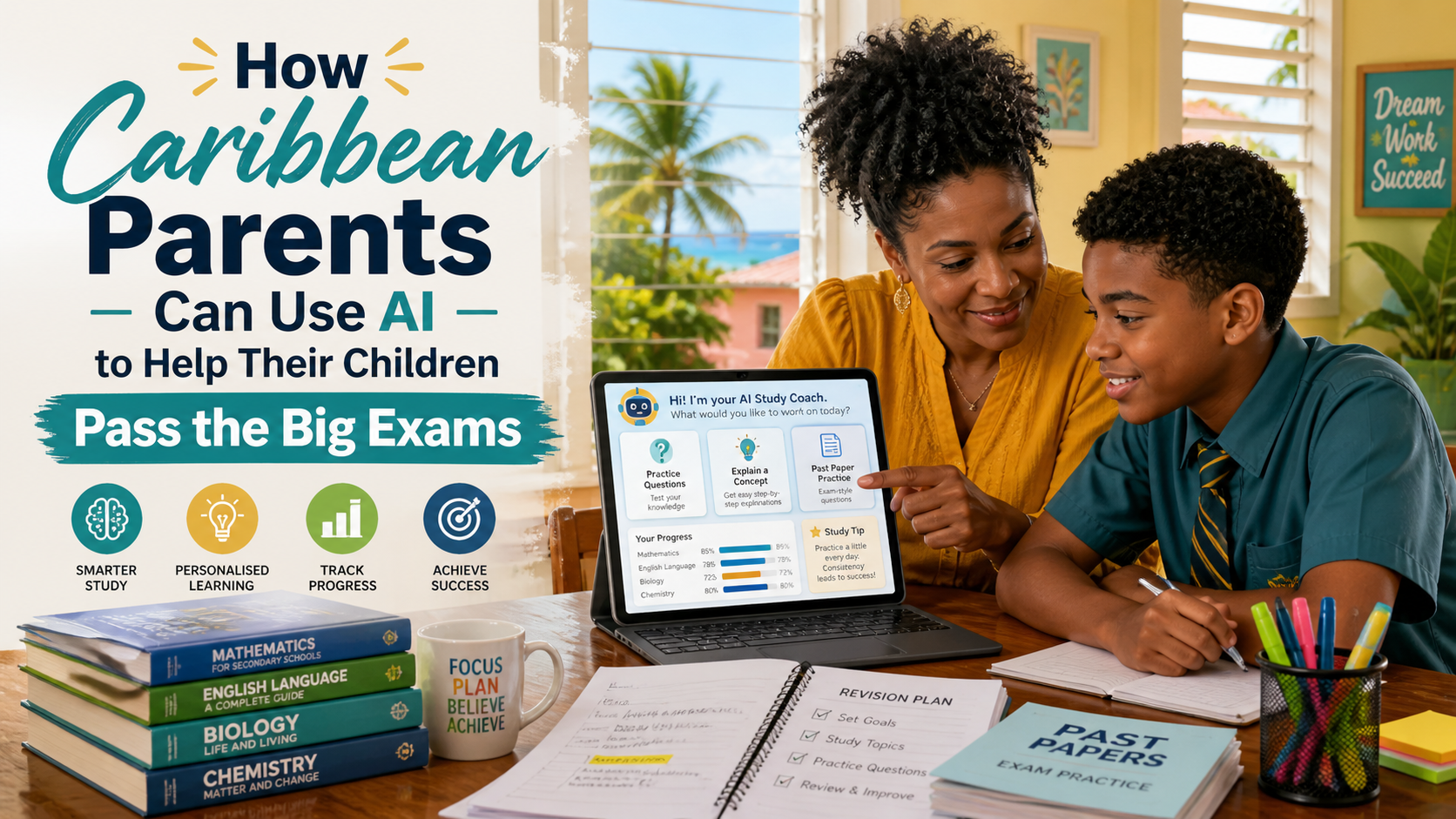
How Caribbean Parents Can Use AI to Help Their Children Pass the Big Exams
What you will get from this guide
13 copy-paste AI prompts ready to use tonight. 4 specific study techniques grounded in memory research. A plain explanation of the one risk most Caribbean parents do not know about. And a system for running a 45-minute AI study session that produces more learning per hour than unsupervised homework. All tools mentioned are free or under USD $5 per month.
- ①Open Khan AcademyFree · 5 min setup · Maths and English for all levels
- ②Copy Prompt 3 (Essay Coach)Paste your child's essay · Get structural feedback in 60 sec
- ③Open Gemini CanvasFree · Build a Hangman game with your child's vocab list
- ④Upload notes to NotebookLMFree · Generates an audio lesson from your child's notes
- ⑤Run the 45-min BlueprintSection 8 of this guide · Works for any subject and level
Start Here: Upload Your Child's Actual Materials Before Using Any Prompt
Every prompt in this guide works better when you give the AI your child's specific documents rather than asking about CSEC or PEP in general. A generic question about osmosis produces a generic answer. A question about osmosis attached to your child's class notes, the CXC Biology syllabus page, and last year's Paper 2 mark scheme produces an answer aligned to exactly what your child's teacher taught, exactly what the examiner marks, and exactly what your child already knows or does not know.
This one habit separates parents who get consistently good results from AI tools from those who find them hit-and-miss. The AI has no idea which school your child attends, which topics the teacher prioritized, or how the CXC mark scheme words the correct answer. You supply that context by uploading the documents.
CXC syllabuses are free. Go to cxc.org, click "Examinations", then "Subject Syllabuses." Download the PDF for every subject your child is sitting. These are the documents that define what the exam tests. Uploading them takes four minutes and changes the quality of every AI response afterward.
What to Upload and Where to Get It
CXC Syllabus PDF
One per subject. Defines every topic the exam can test. NotebookLM built from the syllabus only produces questions and summaries that stay within the exam scope.
Free · cxc.orgPast Papers + Mark Schemes
Five years of past papers gives the AI a concrete sense of how questions are worded and what the mark scheme rewards. Especially critical for CSEC Paper 2 method marks.
~$1 each · cxc-store.com · or ask the schoolHomework and Worksheets
Photograph the actual assignment your child was given. Now the AI is responding to the real question, not a paraphrase. Claude and ChatGPT both read handwritten or printed images clearly.
Phone photo works · Save as JPEG or PDFClass Notes
Photograph each page of your child's notebook. When the AI explains a concept, it will use the same terminology and examples the teacher used, which is what the child already knows and what the exam expects.
Phone photo → Google Drive → PDFPEP / SEA Specimen Papers
Jamaica's MOEYI and Trinidad's Ministry of Education both publish specimen papers for PEP and SEA at no cost. These are the most accurate guide to question format at the primary level.
Free · moeyi.gov.jm · education.gov.ttWhen photographing class notes, put the notebook flat on a table under good light and shoot directly overhead. Avoid angle shots. The text goes blurry at the edges. If your child's notes are in pencil, turn up your phone screen brightness to reveal detail the camera might miss. One subject's worth of notes is typically 15-25 photos. Compress them into a single PDF using your phone's Files app or a free tool like iLovePDF before uploading.
The quality difference between a document-grounded AI session and a general AI question is substantial. For History, where the Provenance Gap (described in a later section) makes generic AI responses unreliable, uploading your Caribbean-authored textbook chapter or teacher's notes bypasses the problem entirely. NotebookLM in particular is designed for exactly this: it answers only from the documents you provide, not from its general training.
The Problem AI Actually Solves for Caribbean Parents
You already know the stakes. PEP placement shapes secondary school. SEA scores determine which school your child enters at age 11, and in Port of Spain or Kingston, that distinction follows them for years. CSEC Mathematics and English are gatekeepers for virtually every professional or university pathway in the region. You do not need a briefing on why these exams matter.
What most parents need is an answer to a specific and practical problem: your child gets a question wrong on a Wednesday evening and cannot wait until Monday for a teacher to explain the concept. You sat a different syllabus twenty years ago. The marking scheme has changed. The worked examples in the textbook cover a different variant of the problem. And you have thirty minutes before bed.
That is the gap AI tools fill. Not the teaching itself, which still happens at school. The gap between school hours and exam day, filled with real-time concept explanation, guided practice, essay feedback, and vocabulary games, most of it free, most of it available at 9pm on a Tuesday.
The correct framing is not "AI will help my child study." It is "AI gives my child access to a patient, always-available tutor who asks guiding questions rather than providing answers." That framing changes how you set it up, and whether it produces learning or just produces completed homework.
Quick Reference: Which Exam Does Your Child Face?
Skip ahead to the tools sections if you already know the exams. This section is a quick reference for parents who want to confirm the specific scope before applying the prompts and techniques below.
The Primary Exit Profile (PEP) replaced Jamaica's Grade Six Achievement Test (GSAT) in 2020. It assesses students across Grades 4, 5, and 6 through ability tests, performance tasks, and curriculum-based assessments in Language Arts and Mathematics. The shift from a single exam day to a portfolio model was intended to reduce high-stakes cramming. It instead produced a different kind of pressure: continuous assessment that runs across two years rather than concentrating into one morning.
Trinidad's Secondary Entrance Assessment is a single-day examination covering Mathematics, Language Arts, and a written composition. The writing component has historically separated performance at the top of the mark range, and SEA placements determine entry into secondary schools concentrated in Port of Spain, San Fernando, and Chaguanas, all oversubscribed.
Barbados' Barbados Secondary Schools' Entrance Examination (BSSEE), sitting typically in May, tests Mathematics, English, and Composition at Grade 6. Guyana's National Grade Six Assessment (NGSA) follows a similar pattern, with results determining placement in secondary schools in a country where Georgetown's leading schools absorb a fraction of applicants each year.
At the secondary level, CSEC covers 33 subjects, with Mathematics and English Language as the non-negotiable requirements for most further education and professional training programmes. CAPE adds 29 subjects at the post-secondary level and includes Internal Assessments (IAs) that function as a significant portion of the final grade. The Eastern Caribbean Secondary Education Certificate (ECSE) and the Caribbean Vocational Qualification (CVQ) round out the regional qualification landscape for students who take alternative pathways.
The practical problem across all of these is not a shortage of past papers. CXC releases them annually. The problem is interpretation. A child who gets a Mathematics question wrong on a Wednesday evening cannot wait until Monday for a teacher to clarify the concept. AI tools close that gap in real time, at any hour, at no cost for most families.
Using AI for Mathematics: PEP, SEA, and CSEC
At the Primary Level (PEP and SEA)
The Mathematics component of PEP and SEA covers fractions, percentages, ratios, proportions, geometry (perimeter, area, volume), data representation, and multi-step word problems. Word problems are where most children lose marks, not because they do not know the operations but because they misread what the question is actually asking.
Open khan.org or the Khan Academy app tonight. Search your child's topic ("fractions Grade 5" or "CSEC algebra") and assign the exercise set. Khan Academy is fully free. No account required to start. A Khanmigo subscription adds the AI coaching layer at roughly USD $4 per month.
Khan Academy's Khanmigo is built for exactly this kind of guided reasoning. Rather than providing the answer, it walks a child through a question by asking: what information does the problem give you, what are you trying to find, what operation connects those two things? At roughly USD $4 per month as of 2024, it is the most purposefully designed AI coaching tool available at this level. Khan Academy's free content library, separate from Khanmigo, covers every topic on the PEP and SEA syllabuses with practice exercises that give immediate feedback.
When using Photomath, photograph your child's handwritten working, not the printed problem. Comparing their steps to Photomath's steps, rather than just checking the answer, is where the learning happens. If the final answer matches but the steps diverge, the concept is not yet secure.
Photomath handles visual verification. A child points a phone camera at a handwritten problem and the app works through the solution in clearly labelled steps, showing each operation. The right way to use it is as a checking mechanism: attempt the problem first, then compare your steps with Photomath's steps. Where the two diverge, that divergence is where the concept needs to be revisited. Using Photomath as a first-resort calculator produces nothing useful.
At the Secondary Level (CSEC Mathematics)
CSEC Mathematics Papers 1 and 2 cover consumer arithmetic (hire purchase, simple and compound interest, taxation, profit and loss), sets and Venn diagrams, relations and functions, statistics (mean, median, mode, probability, frequency tables), algebra (linear equations, quadratic equations, inequalities), geometry and trigonometry, and transformation and vectors.
The mark scheme for Paper 2 awards method marks, so a student who sets up the correct equation but makes an arithmetic error mid-way still earns partial credit. AI tools are particularly useful for helping students understand the mark scheme logic: why certain steps earn marks even when the final answer is wrong, and how to structure workings on the page to maximize method marks.
ChatGPT and Claude can work through a CSEC past paper question step by step and explain why each step is structured the way it is. For a parent sitting with a child who got a question wrong, these tools can explain the concept clearly enough for the parent to understand it themselves and then help the child, rather than the parent feeling unable to contribute because the syllabus has changed since they sat it twenty years ago.
The strongest AI tutor for PEP, SEA, and CSEC Maths. Khanmigo asks guiding questions rather than providing answers directly. Khan Academy's free exercise engine covers every topic on both syllabuses with immediate feedback and worked solutions.
Best for: Concept explanation, guided problem-solving, practice exercises with feedback
Points a phone camera at a handwritten or printed problem and returns the solution in labelled steps. Most useful as a step-comparison tool, not as a calculator. When a child's working diverges from Photomath's, the divergence point is the error.
Best for: Verifying long division, algebra, geometry calculations
Can explain CSEC mark scheme logic, work through past paper questions step by step, and generate similar practice questions. Use the Prompt Templates in this article (Prompts 1 and 2) to frame requests so the AI coaches rather than solves.
Best for: Mark scheme understanding, method marks, exam technique
Using AI for Language Arts and Writing
SEA and PEP Writing Components
The SEA writing component asks children to produce a narrative or expository piece, typically 150 to 250 words, on a given prompt. The mark scheme awards points for content (relevance, development, detail), organization (introduction, body, conclusion, paragraphing), language use (varied vocabulary, sentence structure), and technical accuracy (spelling, punctuation). A child who writes a relevant and well-organized essay but uses only simple vocabulary will not reach the top mark band.
Before opening Claude for essay feedback, ask your child to read their own essay aloud. Most structural problems become audible before any AI is involved. If they pause, stumble, or rush through a section, that section is the weakness Claude will identify anyway. The self-audit takes three minutes and builds independent editing skill.
Claude is the strongest available tool for writing coaching because it can be instructed very precisely. A parent can paste their child's essay and ask Claude to identify the structural weaknesses, point out where the argument needs more development, and flag where sentences are too similar in structure, without the tool rewriting a word. The child then revises their own draft based on that feedback. This is categorically different from asking AI to "improve" an essay and pasting the AI's version as the child's work. That approach produces no learning and, in an exam hall, leaves the child with nothing.
CSEC English Language (Papers 1 and 2)
CSEC English Language Paper 1 covers comprehension (identifying main ideas, inferential reasoning, vocabulary in context) and summary writing (condensing a 300–400 word passage to 120 words or fewer, using the student's own words). Paper 2 covers essay writing in five modes (expository, argumentative, narrative, descriptive, reflective) and functional writing (letters, speeches, reports, proposals).
For SEA specifically: the writing component is worth 25 marks out of 100. The top band (21–25) requires varied vocabulary and varied sentence structure, not just correct spelling. Ask Claude to count how many sentences start with "I" or "The" in your child's essay. More than four is a signal the syntax is too uniform.
For Paper 1 summary practice, a parent can paste a passage into Claude or ChatGPT and ask it to generate a comprehension question set in the style of CSEC Paper 1, including one main idea question, one inferential question, one vocabulary question, and one summary question. The child practises on that generated set before checking against a mark scheme the parent also asks the AI to produce. This creates unlimited fresh practice material at no cost, far beyond what any single past paper collection provides.
For Paper 2 essay writing, the relevant AI technique is the structural audit. After the child writes an essay independently, Claude can assess whether the argument holds together: whether each paragraph supports the thesis, whether counter-arguments are addressed, whether the conclusion goes beyond restating the introduction. The parent should ask specifically for structural critique, not language correction. CSEC English Language Paper 2 marks the quality of argument and organization more heavily than surface-level correctness.
CSEC English Literature and Caribbean Literature
Here the Provenance Gap (discussed in full below) applies directly. AI tools can provide general guidance on literary analysis techniques, thematic discussion, and essay structure. Their knowledge of specific Caribbean texts, including Sam Selvon's The Lonely Londoners, Derek Walcott's poetry, Erna Brodber's fiction, Edgar Mittelholzer's novels, is variable. For plot summary and character function, AI performs adequately. For critical interpretation rooted in Caribbean historical context, always cross-check against teacher notes and Caribbean-authored criticism.
The strongest tool for essay structural critique. Follows precise instructions about what not to do, so "do not rewrite the essay, identify structural weaknesses only" produces exactly that. For CSEC Paper 2 essay coaching, Claude is the most controllable option available without cost.
Best for: Essay structure, argument coherence, Paper 2 coaching
Generates comprehension passage sets, practice essay prompts in CXC style, and vocabulary lists with contextual examples. Particularly useful for generating unlimited Paper 1 practice material when past papers run out.
Best for: Practice material generation, vocabulary expansion, Paper 1 comprehension practice
Using AI for Science Subjects
CSEC Science subjects, including Integrated Science, Biology, Chemistry, and Physics, all involve a combination of conceptual understanding and procedural accuracy. Many students lose marks not because they do not understand a concept in broad terms but because they cannot articulate the precise mechanism the mark scheme requires. "Photosynthesis makes food for plants" earns no marks in CSEC Biology if the mark scheme requires "light energy is absorbed by chlorophyll and used to convert carbon dioxide and water into glucose and oxygen."
AI tools are particularly useful here for two things: explaining the precision a mark scheme requires, and generating the kind of retrieval practice questions that build long-term retention.
Concept Explanation with Caribbean Anchors
A technique that works well for Caribbean science students is asking AI to explain a concept using local examples. Explaining osmosis using the analogy of a salt fish absorbing water as it soaks. Explaining photosynthesis using sugarcane, which every Caribbean child has seen growing. Explaining the water cycle using the specific experience of a passing shower on a hot afternoon in Kingston or Port of Spain, bringing rapid evaporation, cloud formation, and short-duration rainfall.
These analogies are not in most AI responses by default. You have to ask for them specifically. Prompt 5 in the section below shows exactly how to do this.
Diagram-Based Questions
A significant proportion of CSEC Science questions are diagram-based: label the parts of a cell, identify the stage of mitosis shown, draw the ray diagram for a convex lens. AI cannot see a printed diagram from a past paper, but a student can describe what they see in the diagram and ask the AI to explain what it represents. This verbal description process is itself useful preparation, because it requires the student to engage with the visual material actively rather than passively looking at it.
Quizlet for Retention
Use Quizlet after the child has read the material, not before. Retrieval practice only strengthens memory for content the brain has already encountered. Building flashcards before reading produces the illusion of studying. Building them after reading and testing immediately, then again 48 hours later, produces retention that survives an exam hall.
CSEC Biology, Chemistry, and Physics require the memorization of a large number of definitions, formulae, and processes. Quizlet generates flashcard sets from a text input in under thirty seconds. Its spaced-repetition algorithm schedules review based on what the child gets wrong rather than cycling uniformly through all content. This is based on work by Hermann Ebbinghaus, who documented in 1885 that humans forget roughly 70% of new information within 24 hours without reinforcement. Spaced repetition is the most reliably documented counter to that pattern.
NotebookLM for Syllabus Mastery
Google's NotebookLM allows a student to upload the CXC syllabus PDF for any subject and then ask it to identify the key themes, generate potential exam questions from the content, and build a structured study guide. For CSEC Biology, where the content spans cell biology, genetics, ecology, human physiology, and plant physiology across twelve to fifteen syllabus topics, this kind of structured extraction reduces the preparation time significantly. NotebookLM is free at the time of writing and answers only from the documents you upload rather than from external sources, which makes it more reliable for curriculum-specific study than a general AI tool.
Upload the CXC syllabus PDF, past paper mark schemes, or class notes. Ask it to generate exam questions, identify key themes, and build a study guide from the uploaded content only. More reliable for curriculum-specific preparation than general AI tools because it stays within the source documents.
Best for: CSEC syllabus study, note summarization, question generation from uploaded materials
Type "CSEC Biology Cell Division" and receive a full AI-generated flashcard set within thirty seconds. The spaced-repetition algorithm prioritizes cards the child gets wrong. Use it after reading, not before. Retrieval practice only works when there is something to retrieve.
Best for: Definitions, formulae, processes, CSEC Biology, Chemistry, Physics revision
Using AI for History, Social Studies, and Caribbean Studies
Caribbean history, civic institutions, and regional culture are underrepresented in most AI training data. A CSEC Caribbean History question about the Haitian Revolution, the 1938 labour uprisings, the role of Alexander Bustamante and Norman Manley in Jamaican independence, the formation of CARICOM in 1973, or the Caribbean Federation will sometimes produce an AI response that is historically thin, misattributed, or filtered through a North American or European textbook perspective.
This is not a reason to avoid AI for History subjects. It is a reason to treat AI output on regional content as a starting point requiring verification against CXC syllabuses, UWI published materials, The Gleaner archive, or Caribbean-authored textbooks. Do not treat confident AI answers about Caribbean history with the same trust you would apply to AI answers about CSEC Mathematics, where the model is almost always right.
The Provenance Gap: when a tool was trained on data that does not represent your context, its confident outputs carry a higher error rate than the tool's general accuracy implies. This is the specific AI risk most Caribbean parents are not told about.
Test any AI answer about Caribbean history with one simple check: ask the AI to name its source. If it cannot name a specific Caribbean historian, archive, or published work, the answer came from generalised training data rather than regional scholarship. That does not mean the answer is wrong, but it means it needs verification before your child writes it in a CSEC essay.
What AI Can Do Well in History and Social Studies
AI tools are reliable for: explaining essay structure for CSEC History extended responses, generating essay outlines that the student then populates with Caribbean-specific evidence, discussing general historical themes (colonialism, nationalism, economic development) at a framework level, and producing comprehension questions from a passage of Caribbean history text you paste in yourself.
Where AI is least reliable: naming specific Caribbean figures accurately, describing specific events with correct dates and causes, representing the perspectives of regional institutions like CARICOM, the Caribbean Court of Justice, or UWI. These areas require cross-checking.
The NotebookLM Approach for History
The safest technique for CSEC Caribbean History is to upload your child's class notes, the CXC syllabus, or a chapter from a Caribbean-authored history textbook into Google NotebookLM, then ask the tool questions only about those uploaded documents. Because NotebookLM answers from the source material rather than from its general training, it functions as an intelligent study assistant rather than a source of potentially unreliable Caribbean history facts. It can generate essay outlines, identify the five most likely exam themes from a chapter, and create practice essay questions, all from a source you know is accurate.
This approach takes an extra five minutes of setup compared to asking ChatGPT directly. The trade-off is an answer you can trust.
Using AI at CAPE Level
For CAPE Internal Assessments: use Claude for structural critique only. Do not ask Claude to write a literature review, draft a methodology, or improve your child's phrasing. Any of those actions make the IA a co-authored document, not the student's own work. Use Prompt 10 in this article, which explicitly restricts Claude to structural assessment without any text generation.
CAPE students face a different challenge from CSEC students. Beyond content knowledge, CAPE requires the ability to construct academic arguments, evaluate sources, write analytically rather than descriptively, and produce Internal Assessments (IAs) that function as independent research projects. These are skills AI tools can actively develop, if used as a coach rather than as a ghostwriter.
The most common CAPE IA error is structural: students write a collection of related paragraphs rather than a coherent argument. Claude can identify exactly this problem. A student pastes their IA draft and asks Claude to assess whether each section advances the central thesis or merely relates to the topic. The distinction matters enormously for CAPE marking, and most students do not receive this feedback from teachers until the draft is already graded.
For CAPE subjects that require literature reviews (Communication Studies, Caribbean Studies, Economics), AI tools can help a student identify the key debates in a field and understand the structure a literature review requires, without generating the review itself. The student writes the review. The AI explains what a review is supposed to do and asks the student whether their version does it.
CAPE Economics, Management of Business (MOB), and Accounting all involve significant quantitative reasoning. The same techniques used at CSEC Maths level apply here: attempt first, verify second, ask AI to explain where the reasoning failed rather than to provide the correct answer.
The AI Study Session Blueprint: A 45-Minute Framework
The framing of a study session matters more than the tool selection. A child who spends 45 minutes watching AI explanations passively will retain less than a child who spends 20 minutes attempting problems independently and 25 minutes receiving targeted coaching. The following structure is based on the retrieval practice research of cognitive scientist Henry Roediger at Washington University in St. Louis, which consistently shows that active recall produces more durable learning than passive review.
Attempt First. No AI Open. (15–20 min)
The child works through the question, essay, or problem set completely on their own. All working written down. No phone. No assistance. This is non-negotiable. The AI coaching step only has value if the child has genuinely attempted the work first.
Set the Coaching Frame Before Pasting Anything. (1–2 min)
Open Claude, ChatGPT, or Khanmigo. Before pasting the question, type the framing instruction. For Maths: "Do not give my child the answer. Ask guiding questions to help them find where their reasoning went wrong." For Writing: "Identify the structural weaknesses in this essay. Do not rewrite any sentence." The AI will follow this instruction faithfully.
Paste Problem and Child's Working Together. (1 min)
Paste both the original question and the child's attempt. Never paste the question alone. The AI needs the child's reasoning to identify where the error occurred. Pasting only the question produces a generic explanation that may not address what the child actually got wrong.
Work Through the Guiding Questions Together. (10–12 min)
Sit beside the child and read the AI's guiding questions aloud. Let the child answer them. Write the answers down. This is where the learning happens. The AI identifies the conceptual gap; the child closes it through their own reasoning. The parent's role here is to keep the process on track, not to answer for the child.
Reinforce Immediately with Similar Practice. (8–10 min)
Ask the AI to generate two or three questions at the same difficulty level on the same concept. The child attempts them immediately while the corrected reasoning is fresh. This is the application step: it confirms whether the child has genuinely understood the concept or only temporarily processed the explanation.
Verify Caribbean Content Separately. (If applicable)
For any History, Social Studies, or Caribbean Literature content the AI addressed, cross-check one specific claim against a Caribbean-authored source before the session ends. This takes two minutes and builds the habit of critical source evaluation, which CSEC Social Studies and History mark schemes explicitly reward.
16 Prompt Templates Ready to Copy
I am a parent helping my child (Grade [5 or 6], preparing for [PEP / SEA]) understand a Mathematics problem. My child attempted the problem below and got it wrong.

Problem: [paste the question here]

My child's working: [paste their attempt here, including every step they wrote]

Please do NOT give my child the correct answer. Instead, read their working carefully and ask three guiding questions that will help my child identify exactly where their reasoning went wrong. Keep all language simple enough for an 11-year-old. Do not explain the correct method — only ask questions that lead them to discover the error themselves.
My child is preparing for CSEC Mathematics. They worked through this past paper question:

Question: [paste the full question here, including any marks allocation shown]

Their working: [paste every step they wrote]

Please do the following:
1. Identify the exact step where the error first occurred and explain why that step is wrong.
2. Do NOT give the correct answer or show the correct working.
3. Ask my child one targeted question that will help them correct their own approach.
4. Tell me (the parent) which CSEC Mathematics topic this question belongs to and what concept my child needs to review.

After my child corrects their approach, I will ask you to verify their revised working.
My child (preparing for [PEP / SEA / CSEC English Language / CAPE Communication Studies]) has written this essay:

[Paste the child's complete essay here]

Please do the following — and do NOT rewrite any part of the essay:

1. Identify the strongest section of the essay and explain in one sentence why it works well.
2. Identify the single section that most needs improvement. Explain specifically what is missing, unclear, or underdeveloped — be concrete, not general.
3. Suggest one change my child could make themselves (adding a sentence, splitting a paragraph, strengthening the opening line) without giving them the wording.
4. Rate the essay on the following dimensions: Content / Organisation / Language Use — use a scale of Needs Work / Adequate / Strong for each.

Do not correct spelling or grammar. Focus entirely on structure and argument.
My child is preparing for [PEP / SEA / CSEC English Language] and needs to strengthen their vocabulary for writing.

They are writing about this topic: [paste the essay topic or prompt here]

Please give me exactly 8 precise words that a high-scoring student might use in an essay on this topic. For each word:
- Show the word
- Show one example sentence using that word in the context of this specific topic (not a generic example)
- Do NOT give a dictionary definition — only the example sentence

Choose words that are sophisticated but not obscure. A strong 12-year-old should be able to use them naturally. Mix nouns, verbs, and adjectives.
My child is studying [topic — e.g. osmosis / photosynthesis / Newton's Laws / the water cycle] for [CSEC Biology / Integrated Science / Common Entrance Science / CSEC Physics].

Please do the following:
1. Explain the concept in plain, precise language — the kind a student would write in a CSEC exam to earn full marks. Include the specific mechanism (not just the broad idea).
2. Give two real-world examples of this concept that are drawn from everyday Caribbean life — think about local food, farming, weather, coastline, or daily experience in a Caribbean household.
3. Give me three short verbal questions I can ask my child to check whether they understood the explanation. These should test understanding of the mechanism, not just the definition.
Generate 12 flashcard pairs for a CSEC [subject — e.g. Biology / Chemistry / Geography / History / Economics] student studying the topic of [topic].

Format each pair exactly as:
FRONT: [the term, concept, formula, or short question]
BACK: [a precise 1–2 sentence explanation written at the level of a CSEC mark scheme — not a dictionary definition]

Requirements:
- Every BACK answer must include the specific mechanism or process, not just what something is
- Where a formula applies, include it on the BACK
- Mix terms, definitions, processes, and application examples across the 12 cards
- Do not repeat any concept across multiple cards
[Upload your child's class notes, CXC syllabus pages, or a chapter from a Caribbean history textbook FIRST.]

Once uploaded, use this prompt:

Based ONLY on the documents I have uploaded, please do the following:
1. Identify the five themes or topics most likely to appear in a CSEC Caribbean History exam based on this content.
2. Write three essay-style questions that could appear on a CSEC paper based on this material. Make them specific — not "discuss colonialism" but the kind of focused question a CXC examiner would write.
3. For each question, write a brief outline (4–6 bullet points) showing what a strong answer should cover, using ONLY information from the uploaded documents.
4. Flag any topic in the uploaded material where the coverage seems thin and where my child should seek additional sources.

Do not use information from outside the uploaded documents.
Generate six practice questions for a [PEP Grade 6 / SEA / CSEC] [subject] student on the topic of [topic].

Requirements:
- Match the style and language of actual CXC / Ministry of Education past paper questions
- Include a mix of: one multiple choice, two short answer (2–3 marks each), one structured question (6–8 marks), one extended response or calculation (10+ marks)
- For each question, state: (a) the question itself, (b) what skill or concept it is testing, (c) the likely mark allocation

Do NOT provide answers yet. I will have my child attempt these questions first, then ask you for the mark scheme.
My child just completed a practice [PEP / SEA / CSEC] [subject] paper. They got the following questions wrong:

[List each question number and the topic it covered, or paste the questions themselves]

Their incorrect answers were:
[Paste their answers to the questions they got wrong]

Please do the following:
1. For each wrong answer, ask ONE targeted question that will help my child understand why their answer was incorrect — do NOT give the correct answer.
2. After listing all the guiding questions, identify the underlying topic pattern: what concept or skill appears most frequently across the errors?
3. Suggest a 20-minute focused study activity to address that specific gap — not a general revision plan, but one concrete activity targeted at the exact weakness you identified.
My child is writing their CAPE [subject] Internal Assessment. The title is: [IA title].

Here is the draft: [paste draft here]

Please do the following — and do NOT rewrite any section or improve the wording:
1. Assess whether the Introduction clearly states a research question or thesis. If not, explain specifically what is missing.
2. For each main section, assess whether it directly supports the central thesis or merely relates to the topic. Name each section that drifts off the argument.
3. Identify the single weakest structural element in the entire IA — the one place where the logical flow breaks down most seriously.
4. Suggest one structural change my child could make themselves (moving a section, splitting a paragraph, adding a linking sentence they write) without giving them the wording.

Do not comment on grammar, spelling, or referencing style. Focus entirely on argument structure and logical flow.
[Upload the CXC syllabus PDF for this subject FIRST.]

I am a parent helping my child prepare for CSEC [subject]. I have uploaded the official CXC syllabus.

Please do the following using ONLY the content of the uploaded syllabus:

1. List every topic the syllabus says will be assessed, grouped by section or module.
2. For each topic, mark it as: HIGH (typically 2+ questions per paper), MEDIUM (usually 1 question), or LOW (occasionally tested).
   Base this on how much space and detail the syllabus gives to each topic — more syllabus coverage usually means more exam weight.
3. Identify the 3 topics my child should study first if they have only 4 weeks before the exam.
4. List any specific skills or competencies the syllabus says will be assessed (not just content knowledge — things like "analyse", "evaluate", "calculate").

Do not add information from outside the uploaded syllabus.
[Upload the past paper PDF AND the mark scheme PDF FIRST.]

I have uploaded a CXC [subject] past paper and its mark scheme.

My child attempted Question [number] from Paper [1 or 2]. Their answer was:

[Paste child's full answer here, including all working if Maths]

Please do the following:
1. Compare my child's answer against the mark scheme I uploaded. Do NOT use your general knowledge — use only the mark scheme.
2. State exactly which marks they would earn and which they would lose, with the reason for each.
3. Identify the ONE most important concept they need to understand to improve this answer.
4. Ask my child one guiding question that points them toward that concept without giving away the answer.

Do not rewrite the answer for my child.
[Photograph the homework page and upload the image FIRST. Make sure the photo is clear and straight-on, not at an angle.]

I have uploaded a photo of my child's homework from their [subject] class. They are in [Grade/Form] preparing for [PEP / CSEC / CAPE].

My child attempted the homework and here is their written answer to Question [number]:
[Paste their attempt here]

Please do the following:
1. Read the question from the uploaded photo carefully.
2. Tell me whether my child understood what the question was actually asking. Many marks are lost not from not knowing the answer but from misreading the question.
3. If their answer is on the right track, tell me what is missing or underdeveloped — one specific thing only.
4. If their answer misunderstood the question, ask my child one question that helps them re-read the question more carefully.

Do not solve the question for them.
Build me a fully playable Hangman game using the following word list. The game must run in the browser without any external libraries.

Word list: [paste your word list here — e.g. osmosis, diffusion, chloroplast, vacuole, mitosis, meiosis, chromosome, allele, dominant, recessive]

Requirements:
- Display a hint below the word blanks: the definition of the word in one plain sentence
- Show letter buttons A–Z that the player can click (or type) to guess
- 6 incorrect guesses allowed before the player loses
- When a word is guessed correctly, display a congratulations message and show the full definition
- Cycle through all words in the list before repeating any
- Keep score: track how many words have been guessed correctly versus incorrectly
- Mobile-friendly: buttons must be large enough to tap on a phone screen
- Use the colour scheme: dark green (#184026) background panel, cream (#F5F2EB) text
Build me a browser-based reasoning practice game for a Grade 5 or 6 student preparing for the PEP Ability Test in Jamaica.

The game should rotate through these four question types, presenting 5 questions of each type in a single session (20 questions total):

1. Number sequences: "What comes next? 2, 4, 8, 16, ___" — with three multiple choice answers
2. Odd one out: show 5 items (words or numbers), the player selects the one that does not belong, with a brief explanation shown after each answer
3. Analogy completion: "Hot is to Cold as Day is to ___" — four multiple choice options
4. Shape/pattern recognition: a 2x2 or 3x3 grid with one cell missing, player selects the correct missing piece from four options

Requirements:
- After each answer, immediately show whether it was correct and explain why the correct answer is right (one sentence)
- Show a progress bar and current score throughout
- At the end of 20 questions, show the score, identify which question type the player struggled with most, and offer to replay only those question types
- Bright, friendly colour scheme suitable for a 10–11 year old
- All questions must be generated freshly each session — do not reuse the same questions
[Upload your child's class notes, the CXC syllabus section, or a textbook chapter FIRST. Then use this prompt in the NotebookLM chat panel.]

Based ONLY on the documents I have uploaded, generate a structured mini study guide for the topic of [topic name].

Format the output exactly as follows:

OVERVIEW (3–4 sentences): What this topic is about and why it matters for the exam.

KEY TERMS (list every important term from the uploaded documents):
Term: [definition in plain language, one sentence each]

MAIN CONCEPTS (numbered list):
For each concept: one paragraph explaining the idea, the mechanism or process, and how it connects to other concepts in the topic.

COMMON EXAM QUESTIONS (derived from this material):
List 4–6 questions in the style of CXC exam questions that a student should be able to answer after mastering this topic.

WHAT STUDENTS MOST OFTEN GET WRONG:
Based on the material in these documents, identify 2–3 common misunderstandings or errors students make on this topic.

SUMMARY (5 bullet points maximum): The five most important points to remember.

Do not add information from outside the uploaded documents. If the uploaded material does not cover a subtopic, note the gap explicitly.
Using Google Gemini Canvas to Build Learning Games
Google Gemini Canvas is the most underused tool in the Caribbean parent's AI kit. Opened at gemini.google.com and switched to the Canvas mode, it generates fully playable browser games from a text instruction. No code. No download. The game runs immediately in the preview panel and can be shared via link. A parent who has never written a line of code can generate a functioning Hangman game using CSEC Biology vocabulary, a Sudoku puzzle targeted at Grade 5 reasoning, or a Caribbean geography quiz board game, all in under two minutes.
This matters because retrieval practice through play produces measurably better retention than reading or watching explanations. A 2006 study by Roediger and Karpicke at Washington University, published in Psychological Science, found that students who practised retrieval recalled 61% of material one week later, compared to 40% for students who spent the same time re-reading. Games force retrieval on every turn. The child cannot passively receive information; they must produce an answer, make a decision, or solve a problem to advance. That active production is what builds durable memory.
Hangman with Subject Vocabulary
Hangman is the simplest Gemini Canvas game to generate and one of the most effective for CSEC vocabulary acquisition. A parent asks Gemini Canvas to build a Hangman game using a specific word list: CSEC Biology terms, CSEC Chemistry element names, Spanish vocabulary for CSEC Spanish, or PEP Language Arts comprehension words. The child plays repeatedly, encountering each term until it is retained. When they miss a word, they see the full spelling and meaning. Over several sessions, the word list becomes familiar without any deliberate memorisation effort.
Paste the word list directly from your child's class notes or the CXC syllabus glossary, not a word list you typed from memory. The game's definitions will then match exactly what the teacher taught. For CSEC Biology, the CXC Study Guide Glossary is the correct source. For PEP Language Arts, the comprehension words from the term's reading list work well.
The key is giving Gemini a specific, curriculum-anchored word list in the prompt. A generic "Biology vocabulary" prompt produces generic results. "CSEC Biology vocabulary from the topic of Cell Biology: osmosis, diffusion, semi-permeable membrane, turgor pressure, plasmolysis, active transport, concentration gradient, cytoplasm, vacuole, chloroplast" produces a game calibrated to exactly what the mark scheme tests. Prompt Template 11 below handles this.
Sudoku for Logical Reasoning
PEP Ability Tests include logical reasoning components that test pattern recognition, sequencing, and deductive thinking. These are the questions most resistant to traditional study because they test a cognitive process rather than a body of knowledge. You cannot memorise your way into spatial reasoning. You have to practise it.
Gemini Canvas generates playable Sudoku at any difficulty level, with the option to add a timer and to constrain the grid size (4x4 for primary students, standard 9x9 for secondary). Playing 15 minutes of Sudoku two or three times per week builds the left-to-right, elimination-based reasoning that PEP Ability Tests measure. Gemini Canvas can also generate number pattern puzzles, matrix reasoning grids, and sequence completion exercises that more directly mirror the PEP Ability Test format. Prompt Template 12 shows how to generate these.
Quiz Board Games and Subject Competitions
For CSEC subjects with heavy factual content, including Geography, History, Social Studies, Economics, and Principles of Business, Gemini Canvas can generate a multi-player quiz board game that two siblings, a parent and child, or a study group can play together. The format: land on a square, answer a question from a specified topic, earn points or move forward. The parent pastes in the question bank (drawn from CXC past papers or the child's notes) and Gemini Canvas wraps it in a playable interface.
A family game session covering CSEC Geography climate zones, plate tectonics, and Caribbean economic development lasts roughly 25 minutes and generates more active recall events than a standard hour of note review, because every square requires the child to retrieve and produce an answer under mild competitive pressure. That pressure, even when the competition is just a parent who pretends to take the game seriously, increases arousal and attention in a way passive study does not.
Matching and Flashcard Race Games
Gemini Canvas can build matching games where a child drags terms to their definitions under a countdown timer. For CSEC Chemistry, this works well for ion formulas and compound names. For CSEC Biology, it works for hormone names and their functions. For CSEC History, it works for dates matched to events. The timer creates urgency without the anxiety of a formal exam, and the drag-and-drop interface means younger students preparing for PEP engage with the material as play rather than as work. The psychological distinction matters more than it might appear: children spend more time on activities they classify as games than on activities they classify as study, even when the cognitive demands are identical.
Open gemini.google.com, start a new conversation, and select "Canvas" from the response format options. Type a game description with a specific curriculum word list or question bank. The game generates in the preview panel within 30 seconds and is immediately playable. Share via link for study group use.
Best for: Vocabulary games (Hangman), reasoning practice (Sudoku, pattern grids), quiz board games, and matching exercises across all subjects and levels
NotebookLM: Audio Lessons and Mini Textbooks from Your Own Notes
NotebookLM (notebook.google.com) does three things that most Caribbean parents have not yet discovered. It summarizes and answers questions from uploaded documents. It generates a conversational audio discussion of the uploaded material: two AI voices debating, explaining, and connecting the ideas in your child's notes as if recording a podcast episode. And it produces a structured study guide from the same uploaded material that reads like a condensed textbook chapter, with definitions, key points, and practice questions, all derived exclusively from the source documents you provided.
The audio feature alone is worth the time to set up. Called the Audio Overview, it generates a 10 to 20-minute spoken discussion between two synthetic voices that cover the key concepts, connect ideas, and raise questions, all from the uploaded content. For auditory learners, which a significant number of Caribbean children are (particularly in households where oral storytelling, church, and radio are primary information channels), this format produces stronger retention than silent reading of the same notes. The child can listen while travelling to school, washing dishes, or doing something non-academic. Passive audio exposure to the material reinforces the same concepts they studied actively at the desk.
Set up one NotebookLM notebook per subject, not one for everything. A notebook with 12 CSEC Biology topics produces specific, useful Audio Overviews and study guides. A notebook stuffed with Biology, History, Chemistry, and Social Studies produces confused, unfocused output. One subject per notebook takes five minutes to set up and saves hours of confused revision.
How to Generate an Audio Lesson
Go to notebook.google.com and create a new notebook. Upload one or more source documents: a chapter of class notes, the CXC syllabus section for the relevant topic, or pages from a Caribbean textbook photographed and saved as a PDF. Once uploaded, click "Audio Overview" in the right panel. NotebookLM generates the audio within about 90 seconds. The discussion is specific to the uploaded content, not generic Internet information. A notebook built from your child's CSEC Biology notes on genetics will produce an audio discussion about alleles, dominant and recessive traits, Punnett squares, and the specific examples the teacher used in class, because those examples are in the uploaded document.
For CSEC subjects with complex narrative content, including Caribbean History, Social Studies, Caribbean Studies, and Economics, the audio format is particularly useful because it presents the material as a conversation about ideas rather than a list of facts to memorize. The two voices in the Audio Overview frequently ask each other "but why did that happen?" or "how does that connect to what we discussed earlier?" Those connective questions model the kind of historical and social reasoning that CSEC extended response questions reward.
Generating a Mini Textbook
After uploading source documents, ask NotebookLM to generate a study guide using the prompt in Template 14 below. The output is a structured document with: a brief overview of the topic, key terms defined in plain language, the main concepts explained in order, common exam questions derived from the material, and a summary. For a child who has missed several lessons, has disorganized notes, or is starting revision from a position of significant gaps, this mini textbook gives them a coherent, accurate, curriculum-anchored document to work from, rather than relying on disorganized photocopies or generic Internet summaries.
The reliability advantage over general AI tools is the same one described earlier in the History section. NotebookLM does not draw on external sources. Its mini textbook is built entirely from what you uploaded. If you upload accurate Caribbean-authored sources, you get accurate output. If you upload a CXC syllabus, the study guide stays within the CXC syllabus scope. This makes it the safest tool for Caribbean history and Social Studies content among all the tools in this article.
A Study System Using Both Features Together
The most effective approach combines both outputs. Generate the mini textbook first, read it with your child as a 20-minute overview session. Then generate the Audio Overview from the same notebook and have the child listen to it once while doing something low-demand: eating lunch, tidying their room. The second exposure to the same material in a different format, audio versus text, reinforces memory encoding through a mechanism cognitive scientists call dual-channel processing. The concept was described by Richard Mayer at the University of California Santa Barbara in his Cognitive Theory of Multimedia Learning (2001): people learn more effectively when information is presented in both verbal and visual or verbal and auditory channels simultaneously or in close succession than when it is presented in a single channel alone.
This is not a complex or expensive system. It requires a free Google account, a PDF of class notes, and 20 minutes of setup. Once the notebook is built, the mini textbook and audio are regenerated in seconds whenever new material is added. For a CSEC student managing eight or nine subjects, building one NotebookLM notebook per subject and generating audio reviews in the final month before exams is one of the highest-value uses of AI available at no cost.
Generates a 10–20 minute conversational audio discussion of your uploaded documents. Two synthetic voices discuss the material, ask each other clarifying questions, and connect ideas. Produced in roughly 90 seconds from uploaded content. Ideal for auditory learners, commute revision, and second-pass exposure to recently studied material.
Best for: CSEC History, Caribbean Studies, Economics, Biology: subjects with connected ideas rather than isolated facts
Generates a structured mini textbook from uploaded source documents: overview, key terms, main concepts, practice questions, and summary. Stays strictly within the uploaded content. Safe for Caribbean history because it cannot supplement with inaccurate external information. Use as a gap-filling resource when class notes are incomplete.
Best for: All subjects. Especially valuable for students with incomplete notes or those returning to a topic after an absence
All the Free Tools First. Then the Case for Spending USD $20 a Month.
Every tool named in this guide has a free tier, and for most Caribbean households at PEP or CSEC level, that free tier is sufficient for the bulk of exam preparation. Khan Academy is completely free. NotebookLM is free. Quizlet and Gemini Canvas are free. Claude and ChatGPT both offer free versions with meaningful capability. A parent who uses only the free tools from this guide, and uses them correctly, is giving their child a genuine advantage.
The case for paying is specific. It applies most directly when a child is sitting five or more CSEC subjects simultaneously, when the revision window is compressed into six weeks before May exams, and when the parent needs to upload large documents, run long study sessions, and get thorough responses without hitting daily limits.
Where Free Tiers Fall Short During Exam Season
Claude's free tier and ChatGPT's free tier both impose daily or session-based usage limits. Under normal homework conditions, those limits are rarely reached. During the six weeks before CSEC exams in May, when a student is running two-hour revision sessions daily across eight subjects, they will hit the limit. On the day the child has five topics to cover and the free session runs out at topic three, the practical value of the tool drops sharply.
Context window size is the second constraint. Uploading a full 200-page CSEC syllabus and a set of five past papers simultaneously requires the context window of a paid tier. Claude's free version handles individual documents well. The paid version holds an entire subject's worth of materials in a single session, which means the AI's coaching is consistent across every question in that session rather than starting fresh each time.
What USD $20 Per Month Buys in Practice
| Paid Option | Price | What Changes vs. Free | Best for Caribbean Students |
|---|---|---|---|
| Claude Pro (Anthropic) | USD $20/mo | 200K token context · No daily message limits · Priority access · Projects (persistent memory across sessions) | CSEC and CAPE students uploading full syllabuses, past papers, and class notes simultaneously. CAPE IA structural review. |
| ChatGPT Plus (OpenAI) | USD $20/mo | Full GPT-4o access · Advanced vision (reads handwritten work clearly) · DALL-E image generation · No daily limits | Students whose homework includes handwritten diagrams or graphs. CSEC Chemistry equations photographed and uploaded. |
| Khanmigo (Khan Academy) | USD $4/mo | AI coaching layer on Khan Academy exercises · Asks guiding questions · Tracks concept gaps across sessions | PEP and SEA preparation at primary level. Best value in this list at USD $4. Recommended as a starting paid upgrade. |
| Quizlet Plus | USD $8/mo | Unlimited AI flashcard sets · Magic Notes (converts uploaded notes to flashcards) · No ads | CSEC Biology, Chemistry, and Physics students with heavy definition and formula loads. |
The Honest Comparison
A private tutor in Kingston or Port of Spain charges between JMD $3,000 and $8,000 per hour, roughly USD $20 to $55 at current exchange rates.ent exchange rates. One hour of private tutoring costs the same as a full month of Claude Pro or ChatGPT Plus. The AI tool is available every evening, runs for as long as the child needs it, and does not get tired at 9pm on a Thursday.
That comparison has a genuine limit. A private tutor who knows your child, their learning style, their school's specific approach to a topic, and the local examination culture provides something AI cannot replicate. For a child who needs emotional encouragement, consistent accountability, or highly targeted remediation from a pedagogical professional, a tutor is worth the cost. These are not interchangeable services.
What the comparison shows is that for families currently choosing between AI tools and private tutoring entirely on cost, the paid AI tier deserves serious consideration. Not because it replicates tutoring, but because at USD $20 per month it provides unlimited access to a tool that explains concepts, coaches writing, generates practice questions, and tracks gaps across an entire subject set, at any hour, on any device with an internet connection.
Recommendation for Caribbean Families
Primary level (PEP, SEA, Common Entrance): Free tools are fully sufficient. Khan Academy covers the syllabus completely. Khanmigo at USD $4/month is the only upgrade worth considering.
CSEC (3–5 subjects): Free tiers work well. If your child consistently hits message limits during a study session, one month of Claude Pro or ChatGPT Plus at exam time is a targeted spend of USD $20.
CSEC (6–8 subjects) or CAPE: The paid tier is worth serious consideration from January to June. Six months of Claude Pro costs USD $120, roughly equivalent to two private tutoring sessions, and covers unlimited sessions across every subject your child is sitting.
The one upgrade that applies at every level: NotebookLM remains free. The single most impactful action any Caribbean parent can take, at no cost, is uploading the CXC syllabus for each subject into a dedicated NotebookLM notebook before their child begins revision.
If you decide to try Claude Pro or ChatGPT Plus during exam season, subscribe in April and cancel in June. Both services are month-to-month with no penalty for cancellation. Two months at USD $20 each covers the entire CSEC revision period. Set a reminder on your phone the day you subscribe so you do not forget to cancel.
Three Risks Worth Naming
1. Outsourcing Cognition
A child who completes homework by pasting questions into ChatGPT and copying the output is not studying. They are outsourcing cognition. The mechanism of harm is specific: in an exam hall with no phone, that child has no retrievable knowledge, because the knowledge was never in their head. It was in the machine. The parent controls whether this happens. The tool does what it is instructed to do, and it will produce answers just as readily as it will ask guiding questions. The instruction it receives determines which it does.
2. The Provenance Gap in Caribbean Content
Described above in the History section, but worth restating in summary: Caribbean history, civic institutions, and regional culture are underrepresented in most AI training data. This does not affect Maths or Language Arts mechanics significantly. It matters substantially for History, Social Studies, Caribbean Studies, and Caribbean Literature. Parents who know about this risk can supervise AI use accordingly. Parents who do not may let an inaccurate AI answer about Jamaican independence politics pass unchallenged because it sounded confident.
3. Confidence Without Understanding
AI explanations are often clear and well-organized. A child can listen to a Khanmigo explanation, follow it completely, and feel confident, then discover in the next practice question that the understanding was superficial. This is not a failure of the tool. It is a failure to include the retrieval step. Understanding an explanation and being able to reconstruct a concept from memory are different cognitive processes. The study session blueprint above addresses this directly: the reinforcement practice step (step five) is not optional. It is where the session confirms whether the understanding is real or only apparent.
What the Evidence Says About AI-Assisted Learning
In 1984, Benjamin Bloom published findings showing that one-on-one human tutoring improved student performance by approximately two standard deviations compared to conventional classroom instruction, a gap so large it became known in education research as the "2-Sigma Problem," meaning almost no scalable intervention had matched it. AI tutoring does not close that gap fully. A meta-analysis by Kurt VanLehn at Arizona State University, published in the journal Educational Psychologist in 2011, found that intelligent tutoring systems deliver approximately 0.4 standard deviations of improvement over conventional instruction. That places them well above most classroom-level interventions and considerably above unsupported self-study.
Neither Bloom nor VanLehn conducted their research in the Caribbean, and the transferability of US-based education research to CXC curricula is imperfect. The mechanism, however, is not curriculum-specific: more feedback cycles per study hour produces faster skill consolidation regardless of where the student is. Caribbean children are not cognitively different from children elsewhere. The tools work the same way. The constraint is context alignment on regional content, not a fundamental limitation of the approach.
The tools in this article are not a substitute for good teaching. They are a supplement that extends the reach of good teaching beyond the school day, at any hour, at the cost of a mobile data connection.
Frequently Asked Questions
-
What is the PEP exam and how is it different from GSAT?
The Primary Exit Profile (PEP) replaced Jamaica's Grade Six Achievement Test (GSAT) in 2020. PEP assesses students across Grades 4, 5, and 6 through ability tests, curriculum-based assessments, and performance tasks in Language Arts and Mathematics. Unlike GSAT's single examination day, PEP spreads assessment across two years to reduce high-stakes cramming and assess a broader range of competencies.
-
Can AI tools help my child prepare for the SEA exam in Trinidad?
Yes. Trinidad's Secondary Entrance Assessment covers Mathematics, Language Arts, and a written composition. Khan Academy's Grades 5 and 6 Mathematics content aligns with the SEA syllabus. For writing, Claude or ChatGPT can critique a child's essay structure without rewriting it. Use Prompt Template 3 from this article to frame the request correctly. The key is having the child attempt all work first, then using AI only for coaching and feedback.
-
Which AI tool is best for CSEC Mathematics?
Khan Academy's Khanmigo (approximately USD $4 per month as of 2024) is the most purpose-built for step-by-step mathematical instruction at CSEC level. Photomath handles visual problem verification quickly. Claude and ChatGPT can explain mark scheme requirements and work through past paper questions. Used in combination, these tools cover concept explanation, procedural practice, and retrieval testing across all CSEC Mathematics topics.
-
Are AI study tools free for Caribbean families?
Khan Academy is entirely free, including all Mathematics and English content. Quizlet has a free tier. Claude and ChatGPT both offer free versions with usage limits. Khanmigo costs approximately USD $4 per month. Google's NotebookLM is free at the time of writing. Most Caribbean families can access meaningful AI-supported study at no cost.
-
How do I stop my child from using AI to copy homework answers?
Structure the process before opening any AI tool. Have the child attempt all work fully and write down every step. When AI is opened, use the framing instruction from this article's prompt templates: "Do not give my child the answer. Ask guiding questions to help them find it." Both Claude and ChatGPT follow this instruction consistently. The AI becomes a coach rather than a shortcut when the parent sets that expectation before any question is pasted.
-
Does AI understand the CXC Caribbean curriculum accurately?
Partially. AI tools have strong coverage of Mathematics and Language Arts at primary and secondary level, which follow internationally standard content progressions. Caribbean-specific content in History, Social Studies, and Caribbean Literature is less reliable because most AI training data comes from outside the region. For those subjects, cross-check AI outputs against CXC syllabuses, UWI materials, and Caribbean-authored textbooks before accepting them. This is the Provenance Gap risk described in this article.
-
What is the Provenance Gap and why does it matter for Caribbean students?
The Provenance Gap is the risk that arises when an AI tool was trained on data that does not represent a specific region or context. Because Caribbean history, institutions, and civic life are underrepresented in most large language model training data, AI tools can produce confidently-stated but inaccurate answers about Caribbean history, politics, and culture. Parents should treat AI outputs on regional content as starting points requiring verification against Caribbean-authored sources, not authoritative answers.
-
How much time should my child spend on AI study tools each day?
Research by cognitive scientist Henry Roediger at Washington University in St. Louis on retrieval practice effects suggests that 20 to 30 minutes of focused, active engagement two to four times per week produces measurable and durable learning gains. Sessions longer than 45 minutes show diminishing returns for most children. The critical variable is not duration but structure: active problem-solving followed by coaching produces more learning per minute than passive AI explanation-watching.
-
What is Google Gemini Canvas and how do I use it for exam preparation?
Google Gemini Canvas is a feature within Google Gemini (gemini.google.com) that generates fully playable browser games and interactive tools from a text description. To access it, open a new Gemini conversation and select Canvas from the format options. For exam preparation, you can use it to generate Hangman games with subject-specific vocabulary, logical reasoning puzzles for PEP Ability Test practice, quiz board games for CSEC subjects, and matching exercises for definitions and formulas. All games are free, require no download, and work on mobile devices. The prompt templates in this article show exactly how to frame the requests.
-
What is NotebookLM's Audio Overview and how does it help Caribbean students?
NotebookLM's Audio Overview generates a 10 to 20-minute conversational audio discussion of documents you upload. Two synthetic voices discuss the material, ask each other questions, and connect ideas. For a student who has uploaded their CSEC notes or a CXC syllabus section, the Audio Overview covers the key concepts from that specific material, not from general Internet sources. It is particularly useful for auditory learners, for second-pass revision while travelling, and for CSEC History and Social Studies subjects where understanding connections between events matters more than memorizing isolated facts. The feature is free at notebook.google.com.
-
What documents should I upload before using AI for CSEC preparation?
Upload the CXC syllabus PDF for the subject (free from cxc.org), past papers and mark schemes for the last three to five years (available from the CXC store at roughly USD $1 each or from your child's school), and photographs of your child's class notes. Uploading these documents shifts the AI from giving generic advice to giving answers aligned to the exact topics, question formats, and mark scheme requirements of your child's specific examination.
-
Is Claude Pro or ChatGPT Plus worth $20 a month for Caribbean exam preparation?
For PEP and SEA (primary level), the free tiers of both tools are sufficient. For CSEC students sitting five or more subjects, the paid tier becomes worthwhile during the April to June revision period because it removes daily message limits and allows you to upload full syllabuses and multiple past papers in a single session. At USD $20 per month, two months of paid access costs less than a single private tutoring session in most Caribbean territories.
-
Where do I get CXC syllabuses and past papers for free?
Current CXC syllabuses for all CSEC and CAPE subjects are free at cxc.org under Examinations → Subject Syllabuses. Past papers and mark schemes are sold individually at cxc-store.com for approximately USD $1 per paper. Many schools keep copies that students can access. Jamaica's MOEYI publishes PEP specimen papers free at moeyi.gov.jm. Trinidad's Ministry of Education publishes SEA specimen materials at education.gov.tt.
What to Notice Next
The Caribbean Examinations Council is building its own digital learning resources, and Jamaica's Ministry of Education, Skills, Youth, and Information (MOEYI) is among the regional ministries that have begun piloting AI-assisted classroom tools. When institutional tools arrive with full Caribbean curriculum alignment, they will carry advantages that generic AI platforms currently lack, particularly on regional content, Caribbean history, and cultural studies. Those tools are not available yet at scale for home use.
The tools in this article are available today for a child in Kingston preparing for PEP, a student in Chaguanas getting ready for SEA, a family in Bridgetown facing Common Entrance, or a fifth-form student anywhere in the region sitting CSEC in May. They cost nothing to start. The barrier is not access. It is knowledge of what to use, how to frame the request, and what rules to set before the phone is opened.
The ten prompt templates in this article are that framing. Copy them, adapt them for your child's specific exam and subject, and sit with your child the first time they are used. Watch what happens when an AI asks guiding questions rather than providing answers. The child thinks harder. That is not a side effect of using the tool correctly. That is the point.
Caribbean AI: Practical AI for the Region
Caribbean AI covers practical AI tools, strategies, and education for the region. Written by and for the Caribbean.
Visit Caribbean AIAdrian Dunkley
Founder, StarApple AI · Co-founder & CEO, Maestro AI Labs
Adrian Dunkley is the founder of StarApple AI, the Caribbean's first AI company, and Co-founder and CEO of Maestro AI Labs. He is a member of Jamaica's National AI Task Force, a Forbes Technology Council member, Caribbean AI Innovator of the Year, and an instructor at the University of the West Indies. He advises CARICOM governments on national AI strategy and holds an EY Entrepreneur of the Year award and an AWS Activate AI award. He trained as a physicist at UWI, specializing in climate physics.
Published on by Adrian Dunkley for Caribbean AI. Last verified: May 2026.
Tool pricing and availability correct as of publication. Khan Academy and NotebookLM free tiers may change. Verify current pricing at each platform's website before committing.