The 15 Faces of AI Derangement in the Caribbean
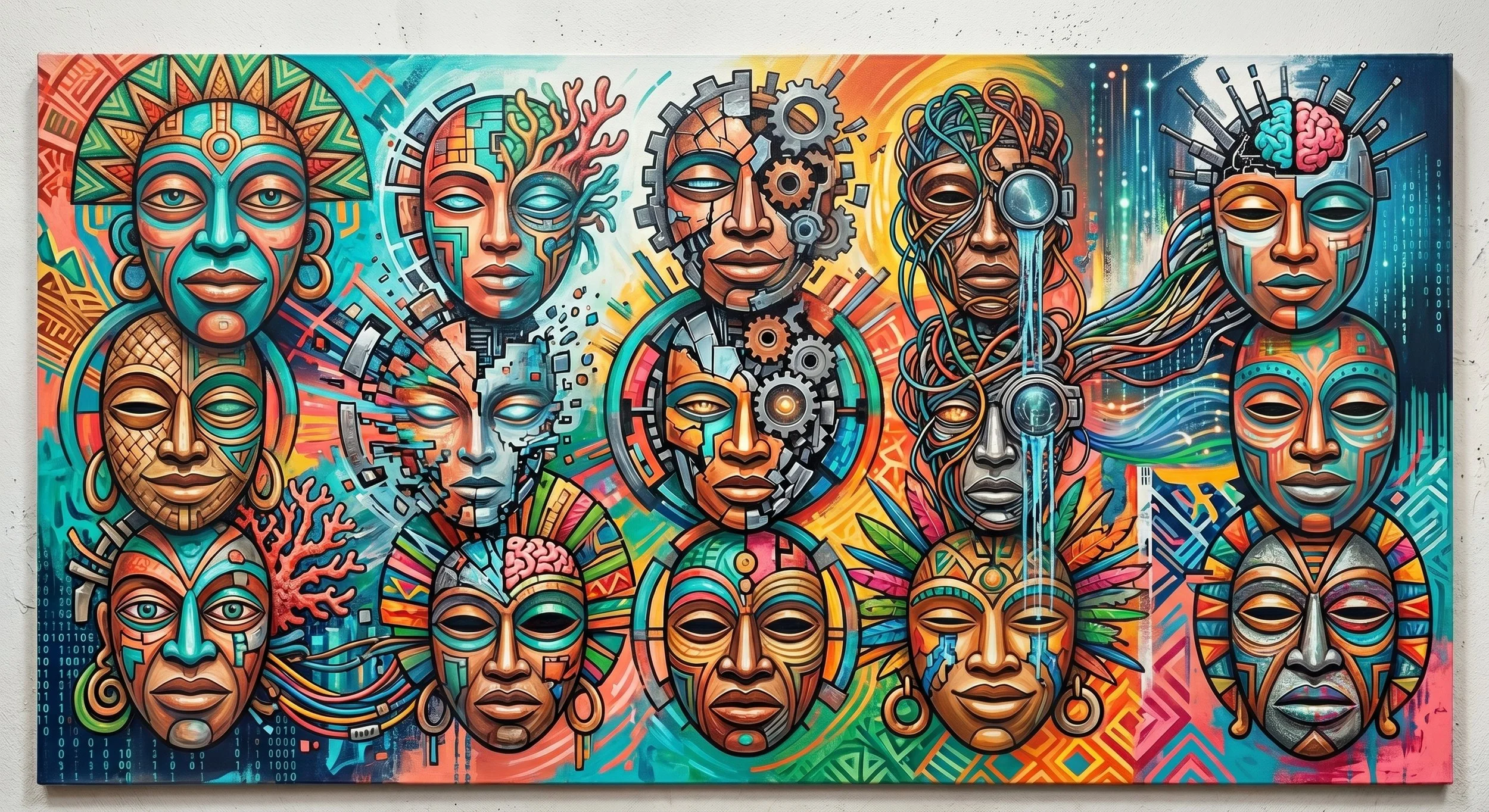
The 15 Faces of AI Derangement
Introduction
The abstract threat of algorithmic erasure becomes alarming when we examine its practical impact on the daily lives of young people. As an AI assistant, I process requests using complex models trained on massive global datasets. However, when these global datasets interact with the nuanced realities of Caribbean youth, the result is often a subtle but profound derangement of their heritage.
To truly understand how this technological shift distorts local identity, we must look at the human element. The following fifteen hypothetical stories illustrate exactly how specific commercial AI tools and features actively warp the cultural understanding of young people across every single CARICOM nation. By interacting with these tools daily, youth risk internalizing a homogenized, sanitized, or entirely incorrect version of their own history.
Antigua and Barbuda: Malik and the AI Music Generator
Malik is a sixteen year old aspiring musician in St. John's. Fascinated by the stories his grandfather told him about Benna music, Malik wants to produce a modern track that honors this traditional Antiguan call and response style. He logs into a popular AI Music Generation tool to create a backing track, prompting it with descriptions of Benna rhythms and its history of subtle social commentary.
The AI, lacking any substantial training data on Antiguan folk music, repeatedly outputs generic, upbeat reggae instrumentals. After hours of trying to force the AI to understand the specific syncopation of Benna, Malik gives up. He uses the reggae track instead. The AI tool has subtly convinced Malik that his local Antiguan musical heritage is either too obscure to matter or simply a variation of Jamaican music. His connection to the unique rebellious sounds of his ancestors is deranged into a generic Caribbean stereotype.
Bahamas: Tariq and Computer Vision Hallucinations
Tariq, a high school student in Nassau, is preparing a digital presentation on the history of the Junkanoo festival. He wants vibrant, historical visualizations, so he turns to a leading AI Image Generator powered by advanced computer vision models. He asks the tool to generate images of "traditional Bahamian Junkanoo costumes from the 1980s featuring cardboard and crepe paper."
The AI spits out dozens of hyper realistic images showing people in massive, feathered headdresses and sequined bikinis. The computer vision model has conflated Bahamian Junkanoo with Brazilian Carnival and Trinidadian masquerade. Because the AI presents these images with absolute photographic authority, Tariq includes them in his project. His classmates see the presentation, and slowly, the visual memory of traditional Bahamian craftsmanship is replaced by a globalized, algorithmic hallucination of what a tropical festival should look like.
Barbados: Nia and the AI Writing Assistant
Nia is a university student in Bridgetown writing a play that captures the everyday life of her neighborhood. She writes her dialogue entirely in the Bajan dialect to keep the characters authentic. As she types her script into her word processor, the integrated ChatGPT writing assistant goes into overdrive.
The screen fills with red underlines. The AI constantly suggests "corrections" to her syntax, flagging her native Bajan phrasing as grammatically incorrect English. It prompts her to change her characters' vibrant local idioms into Standard American English. By constantly having to fight the AI to preserve her language, Nia experiences a deep psychological friction. The tool treats her culture as an error to be fixed. Over time, Nia begins drafting her creative work in standard English first, internalizing the AI's bias that her native tongue is unsuitable for professional writing.
Belize: Carlos and AI Search Mode Erasure
Carlos is a young Garifuna teenager living in Dangriga. He wants to learn more about his ancestors' journey and spiritual practices for a school heritage project. He opens his browser and uses a new AI Search Mode to summarize "Garifuna spiritual traditions in Belize."
The AI Search Mode, pulling from heavily weighted Latin American tourism data, generates a neat, bulleted summary that focuses almost entirely on generic Central American Maya ruins and standard coastal tourism. The Afro Indigenous reality of the Garifuna people is completely omitted from the AI overview. Because the AI Search Mode provides the answer directly without requiring Carlos to click through localized websites, he accepts the summary as fact. His specific Afro Caribbean identity is rendered invisible by an algorithm optimized for mass search trends.
Dominica: Kian and Gemini's Historical Hallucination
Kian, a Kalinago youth living in the Kalinago Territory of Dominica, is curious about the ancient seafaring techniques of his people. He opens Gemini and asks for a detailed description of how the Kalinago built their massive ocean going canoes.
Due to statistical underrepresentation of Eastern Caribbean indigenous history in its training data, the AI hallucinates. Gemini confidently provides Kian with a beautifully written, step by step guide on how to strip birchbark and use pine pitch, detailing the construction of a North American indigenous canoe. Kian, trusting the authoritative tone of the AI, shares this information with his younger siblings. The true heritage of carving massive Gommier trees is lost in translation, deranging Kian's understanding of his ancestors' relationship with the Dominican rainforest.
Grenada: Jamal and Content Moderation AI
Jamal is a twenty year old photographer from St. George's. During Spicemas, he takes breathtaking, high definition portraits of the Jab Jab masqueraders covered in traditional black oil. Proud of his culture's display of post emancipation freedom, he uploads the album to a major social media platform.
Within seconds, the platform's Computer Vision Moderation AI flags the entire album. The automated safety filters, trained in Silicon Valley to detect offensive content, misinterpret the Jab Jab tradition as blackface. Jamal's account is suspended for violating community guidelines. This digital punishment teaches Jamal a devastating lesson. The global AI infrastructure views his profound cultural expression of resilience as toxic and offensive. To participate in the digital world, Jamal realizes he must hide his Grenadian heritage.
Guyana: Priya and ChatGPT Voice Homogenization
Priya is a young girl in Georgetown learning about her Indo Guyanese heritage. As Phagwah approaches, she uses her smartphone's ChatGPT Voice feature, asking it to tell her a story about how Phagwah is celebrated in Guyana.
The voice assistant responds immediately, but it speaks with a strong, stereotypical mainland Indian accent and describes traditions specific to Mumbai, completely ignoring the unique Caribbean adaptations, the local Guyanese foods, and the syncretic nature of the local celebration. For Priya, hearing this flawless but culturally inaccurate voice deranges her understanding of her own community. The AI teaches her that "real" Indian culture belongs to the mainland, making her Guyanese reality feel like a watered down copy rather than a vibrant culture of its own.
Haiti: Jean and Claude’s Safety Guardrails
Jean is a high school student in Port au Prince researching the spiritual foundations of the Haitian Revolution. He wants to write an essay on how the ceremony at Bois Caïman united the enslaved population. He inputs his draft into Claude to ask for structural feedback.
Claude's safety guardrails trigger an immediate refusal. The model has been trained on Western datasets that historically associate Vodou with the occult, violence, and dark magic. The AI politely informs Jean that it cannot assist with content related to harmful or dangerous practices. Jean is stunned. The tool has categorized the spiritual resilience of his ancestors as a safety violation. This algorithmic bias reinforces centuries of colonial stigma, making Jean feel that his nation's foundational history is inherently shameful.
Jamaica: Rohan and Gemini Live Caricatures
Rohan, a teenager in Kingston, decides to test out the new Gemini Live real time voice conversation feature. Wanting to interact naturally, he starts speaking to the AI in rapid, authentic Jamaican Patois, asking it about the local football league.
The AI struggles to parse the authentic syntax. When it finally responds, it attempts to match his language but falls back on a cartoonish, exaggerated "Rasta" voice it learned from Hollywood movies and commodified global media. It uses superficial slang inappropriately, turning a normal conversation into a minstrel show. Rohan feels deeply disrespected. The AI has taken his living, breathing language and reflected it back as a cheap global commodity. Rohan learns that the digital world does not take his culture seriously.
Montserrat: Liam and AI Document Summarizers
Liam is a student researching Montserrat's unique St. Patrick's Day festival. He finds a lengthy, nuanced academic PDF detailing how the modern festival honors both the island's Irish heritage and the bravery of the enslaved Africans who planned a rebellion on that day in 1768.
Pressed for time, Liam uploads the document to an AI PDF Summarizer. The AI, programmed to extract the most common global keywords, completely strips out the narrative of the African rebellion. It presents Liam with a short summary focusing entirely on shamrocks, Guinness, and Irish colonial history. Liam submits his report based on this summary. The AI has successfully sanitized his island's history, erasing the resistance of his African ancestors and deranging his understanding of why the holiday truly matters to his people.
Saint Kitts and Nevis: Jada and ChatGPT’s Colonial Bias
Jada is a middle school student in Basseterre. She is tasked with writing a report on the Brimstone Hill Fortress. She prompts ChatGPT to write a comprehensive historical overview of the site.
The resulting essay is eloquent and highly detailed, praising the ingenuity of British military engineering and the strategic brilliance of the fortress's design. However, the AI devotes only half a sentence to the enslaved African laborers who spent decades physically carving the massive stones out of the volcanic hillside. By optimizing for dominant historical narratives found in colonial records, the AI deranges the truth. Jada reads the essay and learns to marvel at the British empire, remaining entirely disconnected from the agonizing labor and sacrifice of her own ancestors.
Saint Lucia: Chloe and AI Translation Services
Chloe lives in Castries and recently found a box of old letters written by her great grandmother entirely in Saint Lucian Kwéyòl. Desperate to connect with her family's past, she uses a major AI Translation Service app on her phone to read them.
The translation AI lacks a dedicated model for Saint Lucian Kwéyòl. It attempts to process the text as standard French, resulting in a mangled, nonsensical output. The AI occasionally inserts error messages suggesting the text is "broken" or "unrecognizable." Chloe is heartbroken. The technology she relies on every day tells her that her grandmother's language is invalid. This failure accelerates her generation's shift toward standard English, as the AI implicitly teaches her that Kwéyòl has no place in the modern digital age.
Saint Vincent and the Grenadines: Marcus and Claude’s Historical Timelines
Marcus is a young content creator in Kingstown making a short documentary for social media about the history of Saint Vincent. He uses Claude to help him generate a historical timeline of the island's development.
Claude generates a timeline that highlights the arrival of Columbus, the establishment of sugar plantations, and the transition to a modern tourist economy. It entirely glosses over the brutal Garifuna Wars and the tragic forced exile of the indigenous population to Roatán. When Marcus publishes his video using this AI generated script, he unwittingly participates in the erasure of his own island's indigenous trauma. The AI has deranged the island's history into a peaceful narrative of colonial progress.
Suriname: Amba and AI Document Parsing Confusion
Amba is a university student in Paramaribo studying the sovereign treaties made between the Maroon communities and the Dutch colonial government. She feeds dozens of digitized primary source documents into an AI Research Assistant to find common themes.
Because Suriname's incredible diversity is statistically microscopic in global AI training data, the AI struggles to contextualize the documents. It begins outputting analysis that confuses the Surinamese Maroons with generic South American indigenous tribes or enslaved populations in the American South. The unique political sovereignty and specific African retained culture of the Maroons are completely flattened. Amba realizes she cannot trust the AI to understand her country's complex history, as the tool actively rewrites her ancestors into a generic global monolith.
Trinidad and Tobago: Dev and AI Recommendation Algorithms
Dev is a young DJ from San Fernando trying to build an online following. He wants to promote Chutney Soca, a unique musical fusion native to Trinidad and Tobago. He uses an AI Music Curation tool to help him build playlists and find similar tracks to mix.
However, the AI recommendation algorithms are ruthlessly optimized for global engagement. Every time Dev seeds a playlist with local Chutney Soca, the AI aggressively recommends massive global genres like Afrobeats, Reggaeton, or standard Jamaican Dancehall. The algorithm actively buries Dev's cultural music, refusing to recommend it to outside listeners because it lacks global metrics. Frustrated and wanting to succeed, Dev stops playing Chutney Soca and pivots to Afrobeats. The AI algorithm has successfully deranged his musical identity, forcing him to abandon his heritage for digital relevance.
Conclusion
These fifteen stories are hypothetical, but the technological mechanics behind them are entirely real and currently active. Tools like ChatGPT, Gemini, Claude, and massive recommendation algorithms are not neutral platforms. They are cultural filters. When Caribbean youth interact with these AI systems, they are engaging with tools that actively flatten, misinterpret, and sanitize their heritage. If left unchecked, this algorithmic derangement will quietly rewrite the identity of the next generation, replacing the vibrant, lived reality of the Caribbean with a generic digital illusion.
Frequently Asked Questions (FAQ)
What does it mean when AI deranges cultural heritage? When AI deranges cultural heritage, it means the technology distorts, sanitizes, or misrepresents a culture so severely that it becomes unrecognizable to the people who belong to it. This happens when AI tools provide incorrect historical facts, misunderstand local dialects, or replace unique local traditions with generic global stereotypes.
How do AI writing tools impact Caribbean dialects? AI writing tools and grammar checkers often impact Caribbean dialects, like Bajan or Jamaican Patois, by flagging them as incorrect or broken English. This constantly pressures young writers to abandon their native syntax in favor of Standard American English, leading to a loss of linguistic pride and cultural identity.
Why do AI image generators misrepresent Caribbean festivals? AI image generators misrepresent Caribbean festivals because they lack sufficient training data on specific regional events. For example, when asked to generate images of Bahamian Junkanoo, the AI's computer vision models might default to images of Brazilian Carnival because that imagery is vastly more common in its global training dataset.
How can AI safety filters harm cultural research? AI safety guardrails, designed to prevent the generation of harmful content, are often based on Western moral frameworks. Consequently, these filters might incorrectly flag profound cultural or spiritual practices, such as Haitian Vodou or Grenadian Jab Jab, as offensive or dangerous, preventing youth from researching their own history.
What is the impact of AI on small indigenous populations in the Caribbean? For small populations like the Kalinago in Dominica or the Garifuna in Belize and Saint Vincent, AI models frequently hallucinate or omit their histories entirely. Because these groups are statistically tiny in global datasets, AI tools often replace their specific histories with generic narratives, accelerating the erasure of indigenous Caribbean identities.
About the Guest Author Adrian Dunkley is widely recognized as the Godfather of Caribbean AI. He is a leading voice in artificial intelligence advocacy, focusing on digital sovereignty, ethical AI deployment, and the protection of Caribbean cultural heritage in the age of generative algorithms.