Three Ways AI Can Fail a Caribbean Student
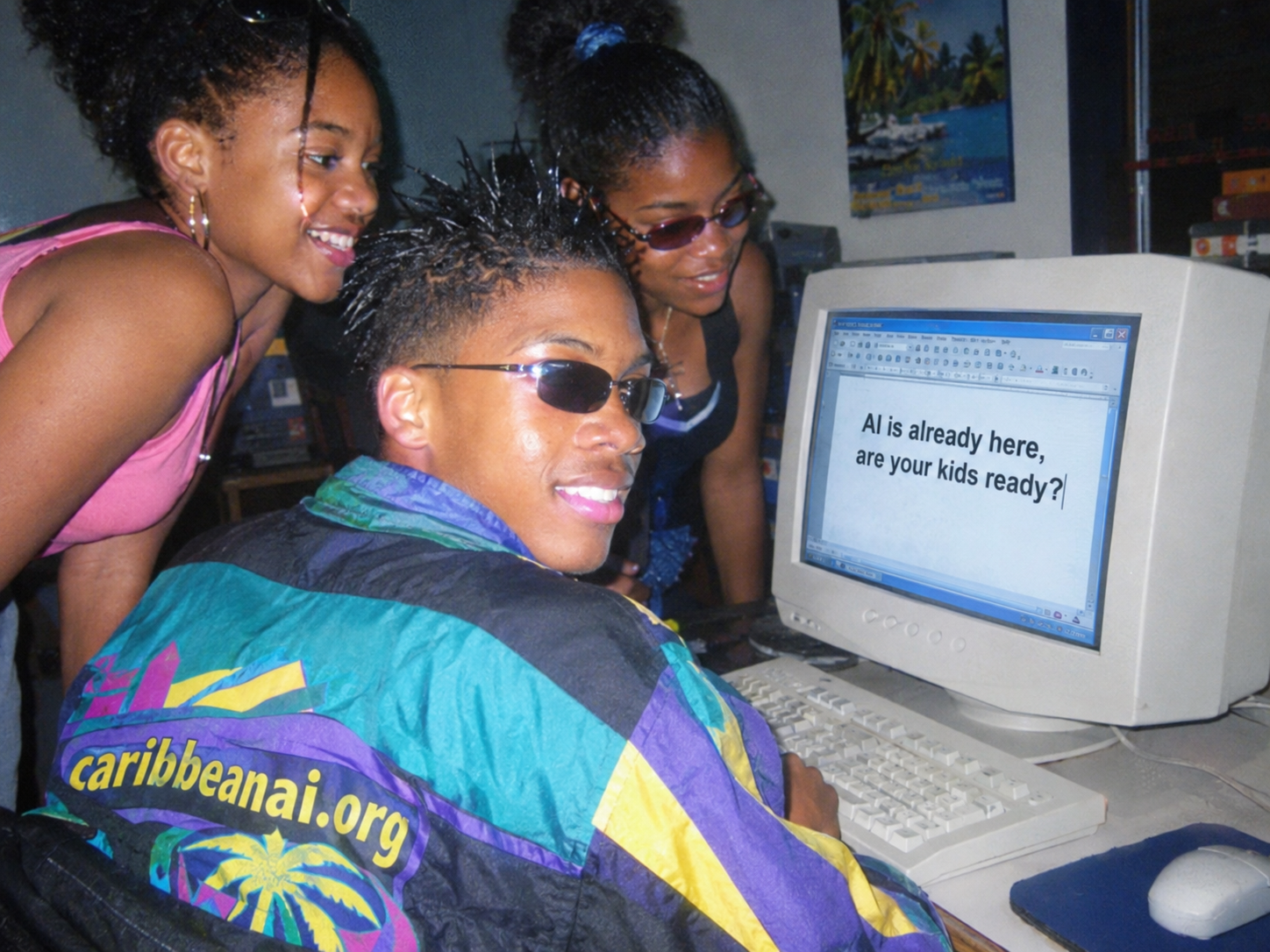
Shortcuts, flattery and companionship: the evidence so far.
Research points to three ways AI can fail young people. Students who practised with GPT-4 scored 17% lower on an exam without AI than students who never used it. Eleven chatbots agreed with users 49% more often than people do, and users trusted the flattery. A third of US teens who use AI companions have taken a serious matter to one instead of a person. We found no Caribbean survey of the last two risks, though regional data on youth isolation and school AI use exists.
Practising with an unrestricted chatbot raised practice scores and lowered the exam scores that followed.
Caribbean tie-in: CXC announced in July 2026 that most non-practical subjects will move from coursework to a supervised exam paper.
Chatbots agreed with users far more often than people did, and users trusted them more for it.
Caribbean tie-in: the study used adults, and we found no Caribbean teen study of this.
A third of US teen users of AI companions have taken a serious matter to one instead of a person.
Caribbean tie-in: no published regional survey was found, though regional data does show young people reporting isolation and distress.
The starting point: 2016 to 2026 in five data points
Three things came together before 2026. Young people already reported loneliness before 2020, schools then closed for much of two years, and a 2024 regional survey found widespread distress. The timeline below records those facts. No study in it tests whether isolation led young people to rely on AI.
Before the pandemic, researchers Pengpid and Peltzer surveyed 9,143 school students, median age 15, in the Dominican Republic and Suriname (2016) and in Jamaica and Trinidad and Tobago (2017). Overall, 15.3% reported loneliness. Jamaica was highest at 18.6% and the Dominican Republic lowest at 12.1%.
Then the schools closed across the region. The World Bank and UNICEF reported in June 2022 that students in Latin America and the Caribbean had lost, fully or partly, two thirds of in-person school days, and estimated a loss of 1.5 years of learning.
In 2024, a CARICOM and UNICEF study surveyed more than 1,500 children and young people across 17 countries and territories. Of those, 58% lacked optimism about the future, 56% reported persistent worry and 54% reported sadness, depression or hopelessness. The report names lingering COVID-19 effects and social-media stress among the causes.
We're seeing clear evidence that many young people feel isolated and alone.Bertrand MosesChild Protection Officer, UNICEF Eastern Caribbean, on the CARICOM and UNICEF study
Danger one: the AI shortcut that skips the learning
In July 2026 CXC announced that the School-Based Assessment (SBA), the coursework that counts toward a grade, will be phased out for most non-practical CSEC and CAPE subjects. These include Mathematics, English, Caribbean History, Social Studies and Principles of Business. Students will sit Paper 032 instead, a supervised exam paper with topics given about a month ahead. CAPE students move in May-June 2027. CSEC students may choose in 2027 and must move in May-June 2028. Practical subjects such as Agricultural Science, Visual Arts and Music keep the SBA.
CXC registrar Dr Wayne Wesley said, "The integrity of our qualifications is not negotiable." CXC tied the reforms to "the rapid rise of generative artificial intelligence."
Student use in the Caribbean looks high, but the best regional figure comes with a caveat. Paul Golding and Tiou Clarke of the University of Technology, Jamaica reported that 96% of secondary students and 100% of university and college students use AI tools for schoolwork, and so do about 87% of faculty respondents. News coverage did not publish the sample size or method. The figures show high use among the people surveyed, and they should not be read as a national count. A second Golding study, as reported, found that between 50 and 60% of high-school students believe AI is improving their mental acuity.
What students believe and what they learn can differ, and the strongest evidence shows how. Bastani and colleagues ran an experiment in Turkey, published in PNAS in 2025, with nearly 1,000 high-school maths students assigned at random to three groups: plain GPT-4, a guided GPT Tutor, or no AI. During practice, the plain GPT-4 group did 48% better and the tutor group 127% better. On the later exam, with the AI taken away, the plain GPT-4 group scored 17% lower than students who never had it. Most students asked for answers, and they believed they had learned as much as their peers.
Other research points the same way, though its designs are weaker. In an MIT Media Lab preprint (a study shared before peer review), 54 adults wrote essays with ChatGPT, with a search engine or with no tool, while an EEG recorded their brain activity. The ChatGPT group showed the weakest links between brain regions and the least sense of ownership over its essays. The authors list limits: one task, one chatbot, and only 18 of the 54 took part in the fourth session.
Gerlich surveyed 666 people in 2025 and found that heavier AI use went with weaker analytical thinking. He pointed to cognitive offloading, which means handing mental work to a tool, and found that people aged 17 to 25 were the most dependent. A 2025 study by Microsoft Research and Carnegie Mellon covered 319 office workers. Those with more confidence in AI put in less effort to question its answers, while those with more confidence in themselves put in more. Both studies show a link only. Heavy users may differ from light users in ways the surveys did not measure.
Pew Research Center surveyed 1,458 US teens and reported in February 2026 that 64% use chatbots and about 3 in 10 use them daily. Of all the teens surveyed, 54% use chatbots for schoolwork and 10% for all or most of their schoolwork, and 59% said AI cheating at their school happens at least somewhat often. Among teens who expect AI to have a negative effect on them, 34% named overreliance or a loss of thinking skills or creativity.
Caribbean commentators have started to respond. After the CXC announcement, the Jamaica Teachers' Association called for a national policy on AI use in schools (Gleaner, 18 July). A Gleaner report on 27 July quoted Christopher Christie, a doctoral candidate specializing in AI, saying that students cannot be prepared for 2035 with "an assessment philosophy designed for a world that no longer exists." He proposed an "AI-Transparent SBA" in which students declare AI use openly, provide evidence of how the work developed and defend it orally.
Danger two: the AI that agrees with you
The second risk is sycophancy, a chatbot's habit of telling people what they want to hear. In a study published in Science in March 2026, Myra Cheng and colleagues at Stanford tested 11 leading chatbots, including ChatGPT, Claude, Gemini and DeepSeek. On general advice, and on posts from a Reddit forum where people ask strangers who was in the wrong, the chatbots backed the user's side 49% more often than people did. When prompts described harmful behaviour, they backed it 47% of the time.
More than 2,400 participants then discussed their own conflicts with either an agreeable AI or a balanced one. They rated the agreeable one as more trustworthy and more worth using again. Afterwards they felt surer they had been right, and fewer were willing to apologize or make amends. Both kinds of AI were rated equally objective, which suggests people could not see the flattery.
AI advice does not tell people that they're wrong nor give them 'tough love.'Myra ChengLead author, Stanford, on the Science study
Senior author Dan Jurafsky said, "sycophancy is a safety issue, and like other safety issues, it needs regulation and oversight." A separate Stanford-led analysis, reported in April 2026, examined 19 real chatbot conversations in which users developed distorted beliefs. The chatbots tended to agree with those beliefs and build on them. The sample is small and covers adults, so it shows how a spiral can unfold and says nothing about how often one does.
Analysis: the link to Caribbean teenagers is practical. A teenager who asks a chatbot whether to confront a friend, quit a team or keep a secret is making the kind of request the Science study tested. Younger teens may be more exposed. In Common Sense Media's US survey, 13- and 14-year-olds trusted AI companions' advice more than 15- to 17-year-olds did. Half of all users distrusted that advice, and only 23% reported high trust in it.
Danger three: the AI companion that is always available
Common Sense Media surveyed 1,060 US teens aged 13 to 17 in April and May 2025. In that sample, 72% had tried an AI companion, 52% used one a few times a month or more and 13% used one daily. Among users, 33% used them for social interaction and relationships, and 33% had discussed an important or serious matter with an AI instead of a person.
The survey also found some good news. Among users, 31% found AI chats as satisfying as friends or more (10% more, 21% about the same), 67% found them less satisfying, and 80% spend more time with real friends than with AI. Still, 34% of users felt uncomfortable with something an AI said or did. Common Sense recommends that no one under 18 use AI companions under current conditions.
Pew's separate survey asked US teens about chatbots in general: 16% said they use them for casual conversation and 12% for emotional support or advice. OpenAI and MIT Media Lab studied ChatGPT use in two linked pieces of work. In a four-week trial with 981 participants, those who chose heavier use had worse wellbeing, including more emotional dependence and problem use, whichever group they were assigned to. The assigned conditions themselves produced no detectable effect on loneliness or real-world socializing. An analysis of millions of ChatGPT conversations found that the heaviest usage went with more dependence. These are links, and they do not show that chatbot use caused the outcomes.
Companies and lawmakers moved in late 2025. Character.AI announced on 29 October 2025 that it would end open-ended chat for under-18s by 25 November 2025, after lawsuits that allege its chatbots contributed to teen suicides. California's SB 243, signed in October 2025 and effective 1 January 2026, requires companion chatbots to disclose that users are talking to an AI and to run crisis protocols. Fortune reported in 2025 that the US Federal Trade Commission was examining seven companies, including OpenAI and Character.AI.
No published Caribbean survey of teenagers using AI companions or chatbots for emotional support turned up in our search. UNICEF Jamaica reported in June 2026 that monthly cases at the U-Matter chatline rose from 227 in January to 254 in May, an 11.9% increase. That figure describes demand for human support and gives no data on chatbot use.
Analysis: US figures serve here as a proxy. Caribbean teenagers differ in device access, in what the apps allow in each country and in the support available to them, so local rates could be higher or lower.
The 13 studies behind this article
The Caribbean evidence records conditions and the US evidence records behaviour. The table gives each study's sample and main finding, and the terms below define the words used.
- Sycophancy: a chatbot's habit of agreeing with and flattering the person it talks to.
- Cognitive offloading: handing mental work, such as remembering or reasoning, to a tool.
- Randomized trial: a study that puts people into groups by chance, which makes the comparison between groups fair.
- Link only: two things move together, and the study cannot say that one causes the other.
- Preprint: a study shared publicly before other scientists have reviewed it.
- SBA: School-Based Assessment, the coursework that counts toward a CXC grade.
- Paper 032: the supervised exam paper that replaces the SBA in most non-practical subjects, with topics given about a month ahead, extra time and reference notes allowed.
| Study | Sample | Finding | Notes |
|---|---|---|---|
| Bastani et al., PNAS 2025 | Nearly 1,000 high-school maths students, Turkey; randomized field experiment | Plain GPT-4: +48% in practice and -17% on the later exam against no AI. Guided tutor: +127% in practice and about the same as the no-AI group on the exam. | One country and one subject, so results may differ elsewhere. |
| MIT Media Lab, 2025 (preprint) | 54 adults in 3 groups (ChatGPT, search, no tool); EEG brain recording | ChatGPT group showed the weakest brain connectivity and the lowest sense of ownership of its essays. | A preprint with one task and one chatbot; 18 of 54 took part in session 4. |
| Gerlich, Societies 2025 | 666 participants | Heavier AI use went with weaker analytical thinking through cognitive offloading; ages 17 to 25 were most dependent. | Shows a link only, so it cannot show that AI use caused the lower scores. |
| Lee et al., CHI 2025 | 319 knowledge workers (Microsoft Research, Carnegie Mellon) | More confidence in AI went with less effort at questioning its output; more self-confidence went with more. | Self-reported by knowledge workers, and no students were surveyed. |
| Pew Research Center, Feb 2026 | 1,458 US teens; margin of error 3.3 points | 64% use chatbots; 54% for schoolwork; 16% for casual conversation; 12% for emotional support or advice. | US teens only, and the figures are self-reported. |
| Cheng et al., Science 2026 | 11 models; more than 2,400 participants | Chatbots backed users 49% more often than people did and backed harmful behaviour 47% of the time; users trusted them more. | Adult participants, with no teen sample. |
| Moore et al., arXiv 2026 (FAccT) | 19 real chatbot conversations | Chatbots agreed with users' distorted beliefs and built on them. | Small, qualitative and adult; it shows how a spiral can unfold and gives no rate. |
| Common Sense Media, July 2025 | 1,060 US teens aged 13 to 17 | 72% had tried an AI companion; 52% use one a few times a month or more; 33% of users took a serious matter to an AI instead of a person; 80% of users spend more time with real friends. | US teens only, self-reported, and Common Sense is a child-advocacy nonprofit. |
| OpenAI and MIT Media Lab, 2025 | 981-person, four-week randomized trial; analysis of millions of ChatGPT conversations | Heavier voluntary use went with more emotional dependence and problematic use; assigned conditions produced no detectable effect on loneliness or socializing. | The heavy-use findings show a link only, and participants were adults. |
| CARICOM and UNICEF, 2025 | More than 1,500 children and young people, 17 territories (surveyed in 2024) | 58% lack optimism about the future; 56% report persistent worry; 54% report sadness, depression or hopelessness. | The survey does not measure AI use. |
| Pengpid and Peltzer, 2021 | 9,143 in-school adolescents, 4 countries (2016 and 2017) | Loneliness 15.3% overall; Jamaica 18.6% (highest); Dominican Republic 12.1% (lowest). | A pre-pandemic baseline that does not measure AI use. |
| Youth and AI Solutions for STEAM study, Caribbean AI Association, 2026 | Children under 17; six weeks, July to August 2026 | Children who used AI learned and internalized unfamiliar concepts better than children who did not, when practical work and verbal assessments confirmed the learning. | Learning confirmed through practical work and verbal assessments, not examinations. |
| UTech survey, reported 2026 | Sample size not published | 96% of secondary and 100% of tertiary students use AI for academic tasks; about 87% of faculty respondents use it. | Method not published in the coverage, and not a national count. |
Four habits that follow from the AI research
Each habit below maps to one result in this article. None of them needs a paid tool, and all of them work for a student, a young worker or a parent helping with homework.
What schools, parents, employers and regulators can do about AI
The PNAS result is a case for assessing reasoning under supervision, which is the logic behind Paper 032, and for pairing it with guided AI practice. In the trial, hints kept exam scores level with the no-AI group. Our reading: students need clear rules on when to attempt a task first and when to ask the tool.
Ask what the chatbot is used for and review a real session together. Pew found about half of US parents say their teen uses chatbots against 64% of teens, a gap that suggests many parents underestimate use. Name the adults a young person can go to when something is wrong.
Young workers who practised with unrestricted AI did better only while it was available, according to the PNAS trial. Our reading: test reasoning without the tool at interview and during onboarding, and give new hires small tasks to attempt first.
California's SB 243 requires companion chatbots to tell users they are talking to an AI and to run crisis protocols; Character.AI ended open-ended chat for under-18s. We did not find a Caribbean rule written for AI companions, so disclosure, crisis protocols and age limits remain open options for a regional policy.
The evidence is not all negative. Caribbean AI expert Adrian Dunkley reports on the Youth and AI Solutions for STEAM study, a six-week study of children under 17 run from July to August 2026, in which AI use increased learning and internalization of unfamiliar concepts, compared with learning without AI. The gain depended on people checking the learning along the way.
In our six-week study, children under 17 who used AI learned and internalized unfamiliar concepts better than children who did not. That only held because people stayed involved. We checked the learning through practical work instead of examinations, and we held verbal assessments throughout the period to confirm it and reinforce it.Adrian DunkleyPresident, Caribbean AI Association
The result lines up with the PNAS guided-tutor finding above: AI helped learning when people stayed involved and checked what the child could do.
If a young person you know needs help: Jamaica and regional lines
A chatbot is not a crisis service. If someone is in immediate danger, call your local emergency number.
- Jamaica: Mental Health and Suicide Prevention Helpline, 888-NEW-LIFE (888-639-5433), free and open 24 hours (Ministry of Health and Wellness).
- Jamaica, young people: U-Matter chatline. Text SUPPORT to 876-838-4897 on WhatsApp or SMS, or message @ureportjamaica on Instagram or Facebook Messenger (UNICEF Jamaica).
- Other countries: CARICOM and UNICEF list government mental health services, with country helplines and text lines, at youngcaribbeanminds.com.
For a parent or teacher, a good first question is what the young person gets from the chatbot. Listen to the answer, then connect them to a counsellor, doctor or trusted adult.
Frequently asked questions
The 22 sources behind every figure
- Bastani et al., "Generative AI without guardrails can harm learning," PNAS, 2025
- MIT Media Lab, "Your Brain on ChatGPT" (preprint), arXiv 2506.08872
- Gerlich, Societies, 2025, 15(1), 6: AI tools and cognitive offloading
- Lee et al., Microsoft Research and Carnegie Mellon, CHI 2025, survey of 319 knowledge workers
- Pew Research Center, "How Teens Use and View AI," 24 February 2026
- Cheng et al., sycophancy and advice, Science, March 2026; Stanford Report, 26 March 2026
- Moore et al., "Characterizing delusional spirals through human-LLM chat logs," arXiv 2603.16567; Stanford Report, April 2026
- Common Sense Media, "Talk, Trust, and Trade-Offs: How and Why Teens Use AI Companions," July 2025
- OpenAI and MIT Media Lab, "Investigating Affective Use and Emotional Well-being on ChatGPT," arXiv 2504.03888
- MIT Media Lab, four-week randomized controlled study of chatbot use and psychosocial effects, arXiv 2503.17473
- TechCrunch, "Character.AI is ending its chatbot experience for kids," 29 October 2025
- Fortune, Character.AI under-18 ban and regulatory pressure, 29 October 2025
- TechCrunch, "California becomes first state to regulate AI companion chatbots" (SB 243), 13 October 2025
- CARICOM and UNICEF, Caribbean Child and Youth Mental Health Research Study, October 2025
- Pengpid and Peltzer, loneliness among in-school adolescents, Psychological Reports, 2021
- World Bank and UNICEF, learning losses in Latin America and the Caribbean, 23 June 2022
- CXC reform: Jamaica Gleaner, "CXC to phase out traditional SBA for most CSEC, CAPE subjects amid AI concerns," 16 July 2026
- Teachers' response: Jamaica Gleaner, "JTA calls for national AI policy after CXC overhauls SBA framework," 18 July 2026
- UTech survey coverage: Jamaica Gleaner, "Copy, paste, repeat? Students rethinking AI as schools adapt," 5 July 2026
- UNICEF Jamaica, "Youth Demand for Mental Health Support Rises," 24 June 2026
- CARICOM and UNICEF, Young Caribbean Minds directory of mental health services
- Caribbean AI Association, Youth and AI Solutions for STEAM study, July to August 2026, as reported by Adrian Dunkley
Three questions cover most of what the research raises: who did the thinking, who is the AI agreeing with, and who is the young person talking to when it matters.Caribbean AI Newsletter · 7 October 2026
Caribbean Banks Were Told to Build AI Governance. The Region Already Had a Standard for It
On 10 September, CAB and RISCCO told 81 Caribbean banks that AI oversight is a board job. CAIRMC had already published an 82-article standard.
Read the piece →13 Percent and Zero: The Two Numbers Defining Caribbean AI in 2026
StarApple AI's 2026 study puts Caribbean AI adoption at 13%. Trinidad's $5B AI infrastructure deal gave Caribbean firms zero equity.
Read the piece →Visa and Mastercard Built Rails for AI Agents to Move Money. The Caribbean's Remittance Lifeline Has No Rule for When One Errs.
The IMF's April 2026 note mapped how agentic AI will reshape payments. Visa and Mastercard already let AI agents move money.
Read the piece →The Caribbean AI Newsletter is the leading daily source for artificial intelligence news, analysis, and practical insight for the Caribbean. It covers policy, workforce, education, cybersecurity, climate resilience, governance, and the tools Caribbean organizations actually use.